



In the past few years, the cross-border e-commerce industry has been undergoing a clear change: sellers' competitive focus has gradually shifted from simply acquiring platform traffic to building their own brand influence and user assets.
In the past, a seller might only need to optimize product pages on e-commerce platforms such as Amazon and eBay, and then acquire orders through advertising. However, as competition on platforms becomes increasingly fierce and traffic costs continue to rise, relying solely on internal traffic from e-commerce platforms is no longer enough to support long-term brand growth.
More and more sellers are turning their attention to overseas social media, hoping to build new growth channels through content, communities, and user interaction.
For example, a new brand may quickly test market feedback through TikTok short videos, showcase its brand image through Instagram, build trust by publishing product reviews on YouTube, and then guide users to an independent website or e-commerce platform to complete a purchase.
Social media is no longer just a simple promotional channel; it is gradually becoming an important gateway for cross-border brands to connect with overseas consumers.
But as the number of platforms increases, new questions have emerged:
Which overseas social media platforms should sellers choose? How should brands at different stages plan their layout? As the number of accounts grows, how can they ensure operational efficiency?
This article will analyze the characteristics of mainstream overseas social media platforms from the perspective of cross-border e-commerce operations, as well as how to build a more stable and efficient social media matrix operation system.
I. Why are cross-border sellers paying increasing attention to overseas social media?
For many cross-border sellers, social media was initially just an auxiliary sales tool. For example, posting product images, sharing discount information, or using it for exposure in coordination with advertising campaigns.
However, as overseas consumers' shopping habits change, social media is influencing the entire purchasing process. From when users first learn about a brand, to learning about products, to finally placing an order, social platforms are playing an increasingly important role.
In the past, when consumers bought products, they usually went directly to Amazon to search for keywords and decided whether to buy based on reviews, price, and ranking.
Now, more and more consumers discover products on social media first. For example, a user may become interested because of a product video on TikTok, then go to Instagram to check out brand content, then learn more through detailed reviews on YouTube, and finally complete the purchase.
This change means that if brands want to achieve growth in overseas markets, they cannot just wait for users to actively search; they need to proactively appear in the scenarios where users become interested.
From traffic acquisition to brand building, social media is changing the way cross-border marketing is done.
The biggest characteristic of traditional e-commerce platforms is that users have clear purchase intent. When users search for a product, they usually already have a strong purchase need.
But the problem is that all sellers are competing for this limited search traffic, leading to increasingly fierce keyword competition and continuously rising advertising costs.
Social media offers another way to grow.
Through content recommendation mechanisms, brands can reach consumers who were not originally actively searching for products. For example, a user may not have planned to buy outdoor supplies, but becomes interested after seeing a video showing product usage scenarios.
This is also why an increasing number of new brands choose to use social media for a cold start, instead of investing a large advertising budget from the outset.
II. How Does Overseas Social Media Influence Consumers' Purchasing Decisions?
Unlike traditional advertising, the process by which social media influences consumer purchases is usually more complex.
Users do not purchase immediately after seeing an ad once; instead, they gradually build trust across multiple platforms and multiple content touchpoints.
For cross-border brands, a complete social media marketing system usually includes three stages:
The first stage: gaining user attention through content
The goal of this stage is not immediate conversion, but to let users become aware of the brand.
Short video platforms such as TikTok and Instagram Reels play an important role in this stage. Through content with viral potential, brands can quickly reach a large number of potential consumers.
For example, a home goods brand can attract user attention by showing the before-and-after changes from using a product; a beauty brand can demonstrate product results through tutorial content.
Stage Two: Build trust through brand content
After users see a product for the first time, they usually do not buy immediately; instead, they learn more about the brand.
At this point, content such as Instagram profile pages, YouTube review videos, and user comments becomes very important.
Consumers use this information to judge:
- whether the brand is genuine and reliable
- whether the product is worth buying
- whether other users have positive feedback
Therefore, social media not only drives traffic but also builds brand trust.
Stage Three: Complete conversions through multiple channels
Mature brands typically do not rely on a single platform to complete sales.
For example:
TikTok is responsible for acquiring new users, Instagram for brand display, YouTube for product education, and Facebook for ad retargeting, ultimately guiding users to Amazon or a standalone website to complete their purchase.
This multi-platform collaborative model has become the development direction for more and more cross-border brands.
III. 10 Overseas Social Media Platforms Worth Watching in 2026
Different social media platforms have different user groups, content formats, and operational logic.
For cross-border sellers, choosing a platform is not simply a matter of looking at user numbers; it should be based on product characteristics, target markets, and their own operational capabilities.
1. TikTok: Ideal for New Product Testing and Brand Cold Starts

TikTok has become one of the fastest-growing content platforms in overseas markets in recent years.
Unlike traditional search platforms, TikTok mainly relies on recommendation algorithms to distribute content. Users do not necessarily actively look for products; instead, they become interested while browsing content.
For cross-border sellers, this mechanism provides an opportunity to test new products.
A new account without a large following can still have a chance to gain high exposure as long as its content is engaging enough for users.
However, the challenges of operating on TikTok are also obvious. An account needs to maintain a stable operating rhythm and accumulate content data over the long term, so the stability of the account environment is very important for long-term development.
2. Instagram: Ideal for Brand Building and Visual Marketing

If TikTok is better at helping brands gain their first exposure, then Instagram is more like a “showcase window” for brands in overseas markets.
After first encountering an unfamiliar brand, many consumers will further check its Instagram profile, using content style, follower engagement, and user reviews to judge whether the brand is trustworthy.
Particularly for products with strong visual attributes, such as beauty, apparel, home, food, and lifestyle, Instagram has very high marketing value.
Cross-border sellers can use Instagram to showcase product details, usage scenarios, and brand stories, allowing consumers to gradually shift from “seeing the product” to “recognizing the brand.”
For example, a clothing brand will not just post product images; it will use styling content, customer posts, behind-the-scenes production processes, and other approaches to help consumers form a more complete brand perception.
But Instagram operations also come with challenges. As brands enter different markets, many companies operate multiple accounts simultaneously, such as accounts for the U.S. market, the European market, and different product lines. How to keep each account running independently and stably will become an issue teams need to address later.
3. YouTube: Suitable for product education and long-term content accumulation

Compared with short-video platforms, YouTube’s biggest advantage is a longer content lifecycle.
A TikTok video may gain a large amount of exposure within a few days, but a high-quality YouTube video may continue to bring traffic months or even years later.
Therefore, for products that require user education, such as electronics, tools, outdoor products, and high-ticket items, YouTube has a clear advantage.
Before purchasing complex products, consumers usually want to learn more information, including product features, usage methods, real experiences, and differences from competitors.
Through YouTube reviews, tutorials, and case content, brands can resolve consumers' doubts in the purchasing process in advance and increase the probability of conversion.
4. Facebook: Suitable for ad placement and user community operations

Although Facebook has been developing for many years, it remains an important platform in the overseas e-commerce marketing system.
Facebook's core value is not just its user scale, but its mature advertising system and community ecosystem.
For sellers who already have stable products and clear target users, Facebook ads can help brands achieve precise reach.
At the same time, community features such as Facebook Group also allow brands to build long-term user relationships.
For example, an outdoor products brand can create an interest community where users share product experiences and exchange usage tips, thereby forming a brand user group.
5. Pinterest: Suitable for visual search and consumption inspiration marketing

Pinterest is different from traditional social media; it is closer to a visual search platform.
Many users turn to Pinterest for home decoration ideas, outfit inspiration, travel plans, and product ideas.
Therefore, Pinterest has strong commercial value for home goods, wedding supplies, apparel, food, and design-related products.
Its advantage is that users usually browse content with clear interests rather than for pure entertainment.
For sellers looking to build long-term brand assets, Pinterest content can continuously gain search traffic.
6. X (Twitter): Suitable for brand communication and building industry influence

Although X does not rely on short videos for rapid growth like TikTok, it still has strong influence in some industries.
Especially in technology, finance, software, AI, and B2B fields, X is an important channel for brands to publish opinions and participate in industry discussions.
For business sellers, X can not only promote products but also establish a professional brand image by continuously sharing industry insights.
7. LinkedIn: suitable for B2B enterprises and business partnerships

If the target customers are not ordinary consumers but corporate procurement staff, partners, or industry clients, then LinkedIn's importance becomes even more obvious.
LinkedIn is more oriented toward professional and business scenarios, making it suitable for:
- B2B product promotion
- Supply chain enterprises
- Enterprise service brands
- Business partnership development
For cross-border companies hoping to enter overseas enterprise markets, LinkedIn is an important channel for building business influence.
8. Reddit: suitable for community marketing and user insights

Reddit's most distinctive feature is its strong community orientation.
Users typically hold discussions around specific interests, product categories, or industry topics.
For sellers, Reddit can serve not only as a promotional channel but also as a way to understand real user needs.
For example, before a product is launched into an overseas market, relevant communities can be used to learn about the issues consumers care about, their purchasing pain points, and feedback on competing products.
9. Snapchat: Suitable for the Young User Market

Snapchat still holds considerable influence among younger user groups.
For brands whose target users skew younger, such as trendy apparel, beauty, and entertainment products, this platform is worth considering.
10. WhatsApp: Suitable for Customer Retention and Private-Domain Communication

WhatsApp has an extremely high usage rate in many overseas markets.
For cross-border sellers, it primarily serves customer communication and user maintenance functions.
For example:
- After-sales service
- Customer inquiries
- Order communication
- User relationship maintenance
Compared with public social platforms, WhatsApp is closer to a brand's private domain operations tool.
Four. How should cross-border sellers at different stages choose social media platforms?
Not all sellers need to operate all platforms at the same time.
The reason many companies fail is not that they chose the wrong platform, but that without clear resources and goals, they simultaneously roll out a large number of channels, making it impossible to sustain operations on every platform.
A more reasonable approach is to choose key platforms based on the brand's stage of development.
New brand stage: prioritize validating market demand
For new sellers who have just entered overseas markets, the primary goal is not to build a complete matrix, but to validate whether there is a market for the product.
At this stage, it is more suitable to choose platforms with strong content distribution capabilities, such as TikTok and Instagram.
Through short videos and user feedback, you can quickly determine:
- Whether users are interested in the product
- Which selling points are easier to spread
- Which markets have more potential
Growth stage: build brand influence
Once the product has received some market feedback, you need to shift from pure selling to brand building.
At this stage, you can add platforms such as YouTube and Pinterest to build user trust through long-term content.
Mature brand stage: build a social media matrix
When a company enters the stage of scaled operations, a single platform can no longer meet its growth needs.
Brands typically need to cover the following at the same time:
- User acquisition channels
- Brand display channels
- User retention channels
- Ad placement channels
At this point, social media matrix operation becomes an inevitable choice.
Five. Why Has Social Media Matrix Operation Become a Trend?
In the past, a brand might only need to maintain a single official account.
But now, competition in overseas markets is fiercer, and a brand often needs to operate multiple platforms and multiple accounts at the same time.
For example:
品牌账号
↓
TikTok美国市场账号
Instagram品牌账号
Facebook广告账号
YouTube内容频道
Pinterest产品展示账号
Different accounts take on different tasks and work together to drive brand growth.
But as the number of accounts increases, management difficulty also rises.
The Biggest Account Management Challenge in Multi-Platform Operations
1. Multi-Account Login Environments Are Difficult to Keep Stable
Many teams initially use ordinary browsers to manage multiple social media accounts.
The problem with this approach is that multiple accounts share the same browser environment.
As the number of accounts increases, cookies, caches, and login states can easily become mixed together, and team management costs continue to rise.
2. Multi-Member Team Collaboration Can Easily Cause Account Chaos
When enterprises operate multiple overseas social media accounts, multiple people are usually required to participate.
If there is no clear way to manage the account environment, the following problems are likely to occur:
- Account login confusion
- Duplicate operations
- Permission management difficulties
3. Accounts for different markets need to be operated independently.
Many brands create different social media accounts for different countries.
For example, the U.S. market, the European market, and the Japanese market may have different content strategies.
These accounts need to be managed independently, rather than all being operated in the same environment.
Seven. How does the P1 fingerprint browser help cross-border sellers manage overseas social media matrices?
When companies begin operating multiple overseas social media accounts, the truly difficult problem is often no longer “how to register accounts,” but how to manage these accounts stably over the long term.
When many cross-border sellers have only a small number of accounts, they directly use ordinary browsers such as Chrome for management. However, as the business grows, a team may be responsible for dozens or even hundreds of overseas accounts at the same time, and traditional browser management methods can hardly meet long-term operational needs.
The biggest limitation of ordinary browsers is that multiple accounts usually share the same browsing environment. Different accounts may share Cookies, cache, browser parameters, and login status. As the number of accounts increases, not only does management efficiency decrease, but it also easily leads to confusion in account operations.
By creating independent browser environments, the P1 fingerprint browser helps users isolate the environments of different social media accounts, giving each account a clearer operating space.
1. Create independent browsing environments for different social media accounts
For social media matrix operations, an important principle is that different accounts should have relatively independent operating environments.
For example, a cross-border brand operating TikTok, Instagram, and Facebook accounts at the same time can create separate P1 browser environments for each:
TikTok美国市场账号
↓
P1独立浏览器环境A
Instagram品牌账号
↓
P1独立浏览器环境B
Facebook广告账号
↓
P1独立浏览器环境C
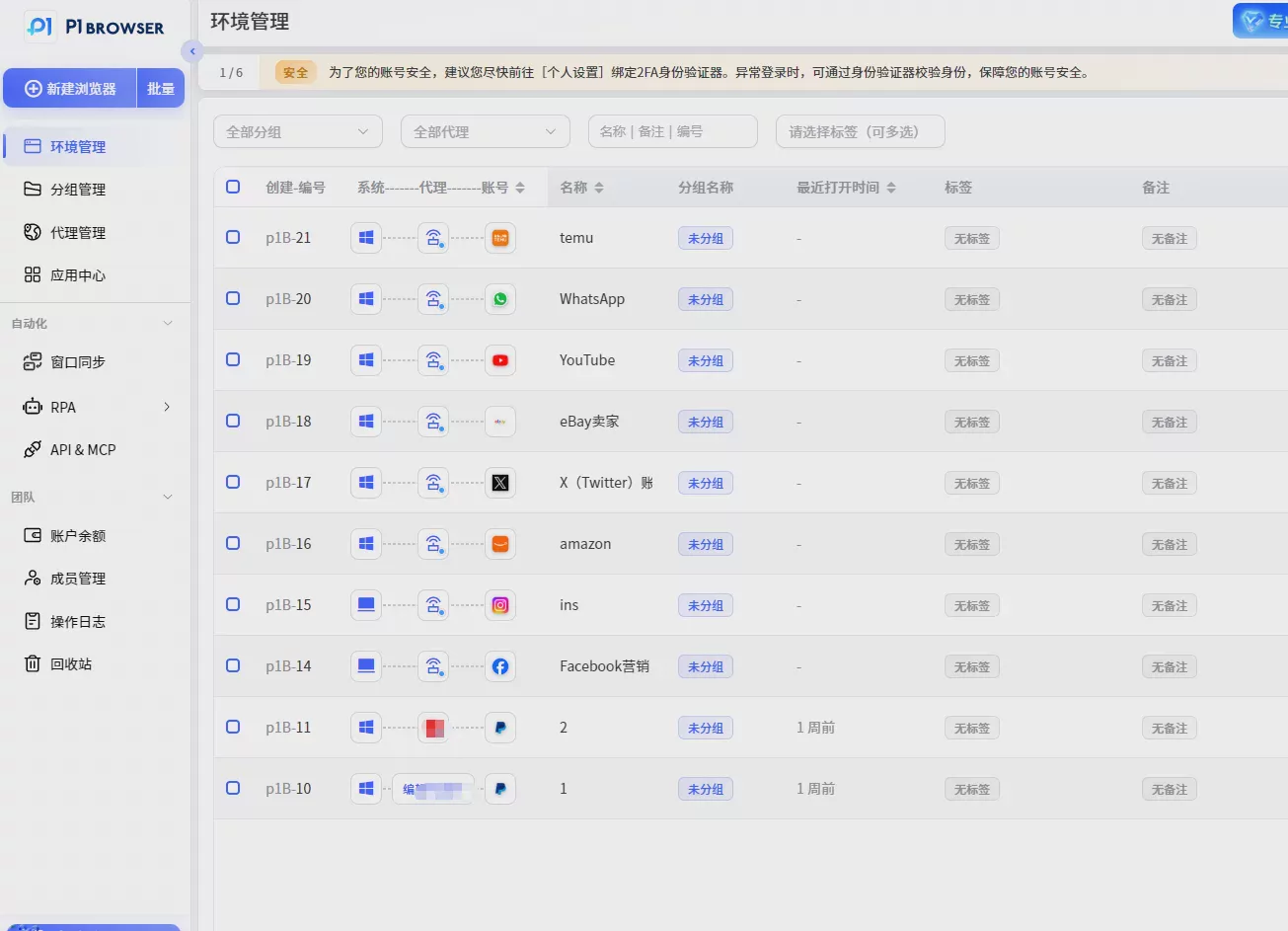
This allows team members to enter the corresponding environment based on account needs and perform operations, without having to frequently switch between multiple accounts.
2. Reduce Multi-Account Management Complexity
As the social media matrix expands, the most common problem companies encounter is disorganized account management.
For example:
- Not knowing which employee is responsible for which account
- Login information for multiple accounts gets mixed up
- Disorganized management of accounts across different markets
- Difficulty with account handovers
P1 can help teams create and manage different browser environments based on business needs, making account management clearer.
For enterprises with multiple brands, multiple markets, or multiple content accounts, this management approach can reduce repetitive operations in daily operations and improve team collaboration efficiency.
3. Suitable for cross-border team collaboration scenarios
Overseas social media operations are usually not a one-person job.
A complete team may include:
- Content operations staff
- Ad placement staff
- Data analysis staff
- Customer operations staff
If all staff log in to different accounts through the same browser, it is not only difficult to manage but also detrimental to a company's efforts to establish standardized processes.
With P1指纹浏览器, teams can assign corresponding browser environments based on roles, allowing different members to complete their work according to their permissions.
4. Supports the long-term social media operation needs of cross-border sellers
Social media marketing is not a short-term project but a long-term process of accumulation.
A truly mature overseas brand needs continuous maintenance of:
- Content publishing cadence
- User interaction relationships
- Brand account assets
- Operating strategies for different markets
Therefore, account management methods also need to gradually upgrade from temporary operations to systematic operations.
The value of P1 fingerprint browser is not simply to help users open multiple browser windows, but to help businesses build a more standardized overseas account operation system.
Eight. How to Build a More Efficient Overseas Social Media Operations System?
For cross-border sellers seeking long-term development, social media operations cannot focus only on "how many accounts to open"; more importantly, they need to establish a complete process.
Clarify the role each platform plays
Different platforms should take on different tasks, rather than all platforms publishing exactly the same content.
For example:
- TikTok is responsible for new product exposure and traffic acquisition
- Instagram is responsible for brand presentation and user trust
- YouTube is responsible for in-depth content and product education
- Facebook is responsible for ad placement and user retention
Clarifying platform positioning can prevent duplicated efforts across teams and improve operational efficiency.
Establish account management standards
As the number of accounts grows, businesses need to establish a unified management process.
This includes:
- Categorized account management
- Assignment of account owners
- Content publishing schedules
- Recording of operational data
Only by establishing standardized processes can a social media matrix truly deliver value.
Conclusion: The overseas social media matrix has become an important direction for cross-border growth.
For cross-border sellers, overseas social media is no longer just an additional promotional channel; it is becoming an important part of brands acquiring users, building trust, and driving growth.
However, as the number of platforms increases, multi-account and multi-platform operations also bring new management challenges.
Future competition is not just about who can enter more markets, but who can manage multiple channels more efficiently and continuously build brand influence.
From TikTok acquiring new users, to Instagram building brand image, to YouTube deepening user awareness, different platforms together form an overseas market growth system.
A stable and efficient account management environment is an important foundation for supporting the long-term operation of a social media matrix.
P1 Fingerprint Browser, through independent browser environment management, multi-account collaboration, and environment isolation capabilities, helps cross-border sellers manage overseas social media accounts more efficiently and provides more stable foundational support for brands' global operations.