


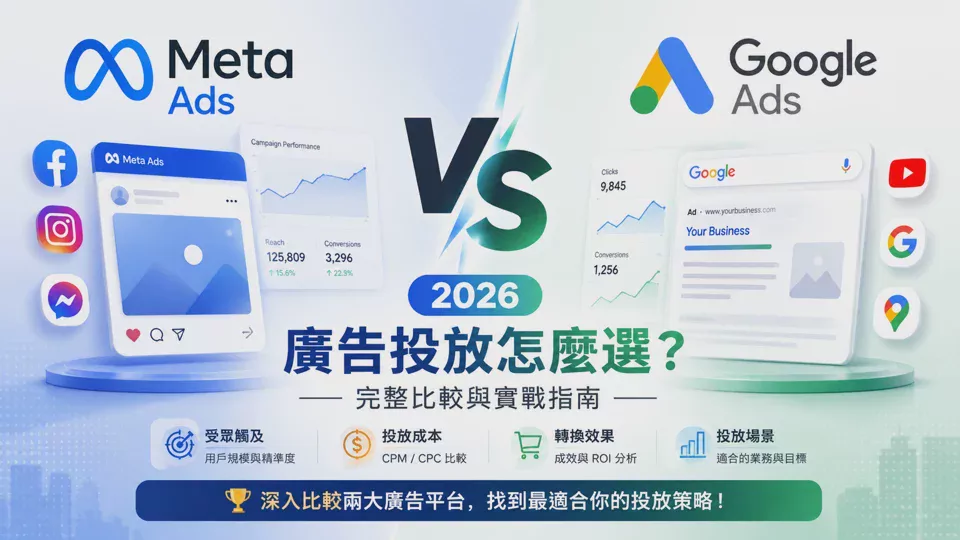
In the fields of digital marketing and paid advertising,Meta Ads and Google Ads have consistently been the two advertising platforms most commonly used by businesses.
When many advertisers begin running campaigns, they encounter the same question:
Which is better, Meta Ads or Google Ads? When the budget is limited, which one should they prioritize?
In fact, there is no absolute answer as to “which one is more powerful.” The real difference is that users are in completely different states when they see the ads.
The core advantage of Google Ads isCapture existing search demand; Meta Ads, on the other hand, is better at proactively reaching potential customers through community platforms such as Facebook and Instagram, building brand awareness and stimulating demand.
Simply put:
Google Ads is when users actively search for you, while Meta Ads is when you proactively find potential customers.
As we enter 2026, with the continued development of AI-automated ad delivery, smart bidding, and advertising algorithms, advertisers increasingly need to choose the right advertising strategy based on their products, budgets, and marketing objectives.
This article provides a comprehensive comparison of Meta Ads vs Google Ads, covering audiences, costs, conversions, e-commerce, B2B, and advertising account management, to help you find the advertising platform that best suits your needs.
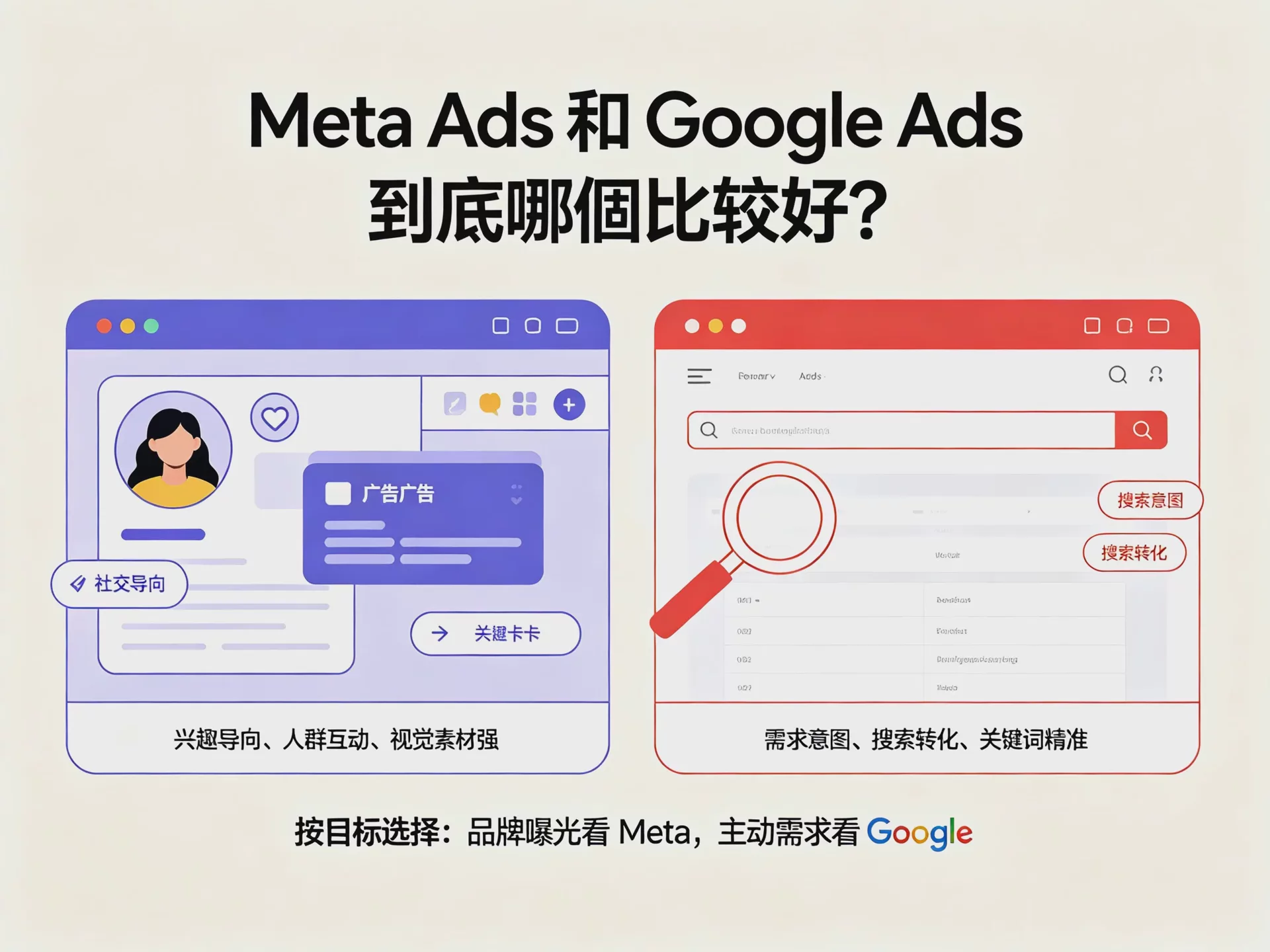
What is the biggest difference between Meta Ads and Google Ads?
If we distinguish between the two in just one sentence:
Google Ads captures demand, while Meta Ads creates and expands demand.
This difference directly affects the audiences, creative assets, costs, and conversion methods of your ads.
Google Ads: Search Intent at Its Core
The biggest advantage of Google Ads is that it can reach users who are actively searching for products or services.
For example, users might search on Google for:
- Recommended fingerprint browsers
- Anti-detect browsers
- Facebook advertising tools
- Google Ads agencies
- Shopify website building services
- Multi-account management tools
These users usually have relatively clear needs. They are not simply browsing content; they are looking for solutions.
Therefore, Google Ads is particularly suitable for:
- B2B business services
- SaaS software
- High-ticket products
- Local services
- Cross-border e-commerce
- Products with clear search demand
The advantage of Google Ads is that user intent is typically higher, making it more suitable for capturing traffic from users who are close to making a purchase or submitting an inquiry.
However, high intent usually also means more intense competition. Popular keywords may have higher cost per click, so ongoing keyword optimization, search term analysis, and negative keyword management are required.
Meta Ads: Centered on audience and content reach
Meta Ads primarily covers platforms such as Facebook, Instagram, and Messenger.
Unlike Google Ads, Meta users typically do not enter the platform with a clear purchase intent.
They may be:
- Browsing their Facebook feed
- Watch Instagram Reels
- View friends' posts
- Watch short videos
- Explore content of interest
Therefore, Meta Ads are better suited for actively attracting potential customers through images, videos, and ad creatives.
Advertisers can test ads based on different audience signals and data, such as:
- Location
- Age
- Interests
- Behaviors
- Website visitors
- Custom audiences
- Remarketing Audiences
One of the biggest advantages of Meta Ads is that they are well suited to large-scale testing of different ad creatives. They typically offer significant potential for visual products, e-commerce brands, and businesses that need to build brand awareness.
Meta Ads vs Google Ads: Core Comparison
| Comparison Criteria | Google Ads | Meta Ads |
|---|---|---|
| Core Advantage | Capture Search Demand | Build Brands and Create Demand |
| User Status | Actively Searching | Browsing Communities |
| Purchase intent | Usually high | Low to medium; requires nurturing |
| Suitable creative | Keywords, text, product information | Images, videos, Reels, creative content |
| Suitable industries | B2B, SaaS, services | E-commerce, brands, lifestyle products |
| Brand exposure | Medium to high | Very suitable |
| Search demand | Highly suitable | Relatively weak |
| Remarketing | Suitable | Highly suitable |
If you want to acquire high-intent customers quickly, you should choose Google Ads
If there is already clear search demand for your product, Google Ads is usually the better platform to test first.
For example, a company provides fingerprint browser services.
When users search for:
- Fingerprint browser
- Anti-detect browser recommendations
- Multi-account browser
- Anti-detection browser
These users usually already know that they need to solve a specific problem.
At this point, reaching them through Google Search ads can directly address their existing needs.
Google Ads are particularly suitable in the following situations:
- You need to generate inquiries quickly
- Customers actively search for your product
- You provide B2B or SaaS services
- Your product has a relatively high average order value
- You need to acquire high-intent traffic
If you want to build your brand and expand exposure, Meta Ads are more suitable
If your goal is not to drive immediate conversions but to get more people familiar with your brand, Meta Ads are usually more advantageous.
Especially for new brands, new products, or products that require market education.
Many potential customers may not even know your product exists, so they naturally will not actively search for it on Google.
In such cases, Meta Ads can proactively showcase the product through images, videos, and short-form videos.
Common ad formats include:
- Image ads
- Video ads
- Reels ads
- Carousel ads
- Dynamic ads
- Lead ads
If the product itself has strong visual appeal or needs to attract users' attention through content, Meta Ads will usually offer greater potential.
Should e-commerce advertising use Meta Ads or Google Ads?
For cross-border e-commerce and direct-to-consumer sellers, the best answer is usually not an either-or choice.
Meta Ads and Google Ads can handle traffic at different stages.
Google Ads: Capturing active search traffic
When consumers already know what they want to buy, Google Search and Shopping ads can help brands reach these high-intent users.
For example, when users search for a specific product name, model, or product category, they are usually already close to making a purchase.
The defining characteristic of this type of traffic is:
Users already have a need.
Meta Ads: Stimulating purchase interest through content
Meta Ads are better suited to showcasing products.
They are especially suitable for:
- Fashion
- Beauty products
- Home goods
- Fitness products
- Lifestyle products
- Novelty products
A good short-form video or Reels ad can spark interest in users who originally had no plans to make a purchase.
Therefore, many e-commerce brands adopt the following approach:
Meta Ads create interest → Google Ads capture search demand → Remarketing boosts conversions
Which costs less, Meta Ads or Google Ads?
Many advertisers directly compare CPC, or cost per click.
However, this comparison is not complete in practice.
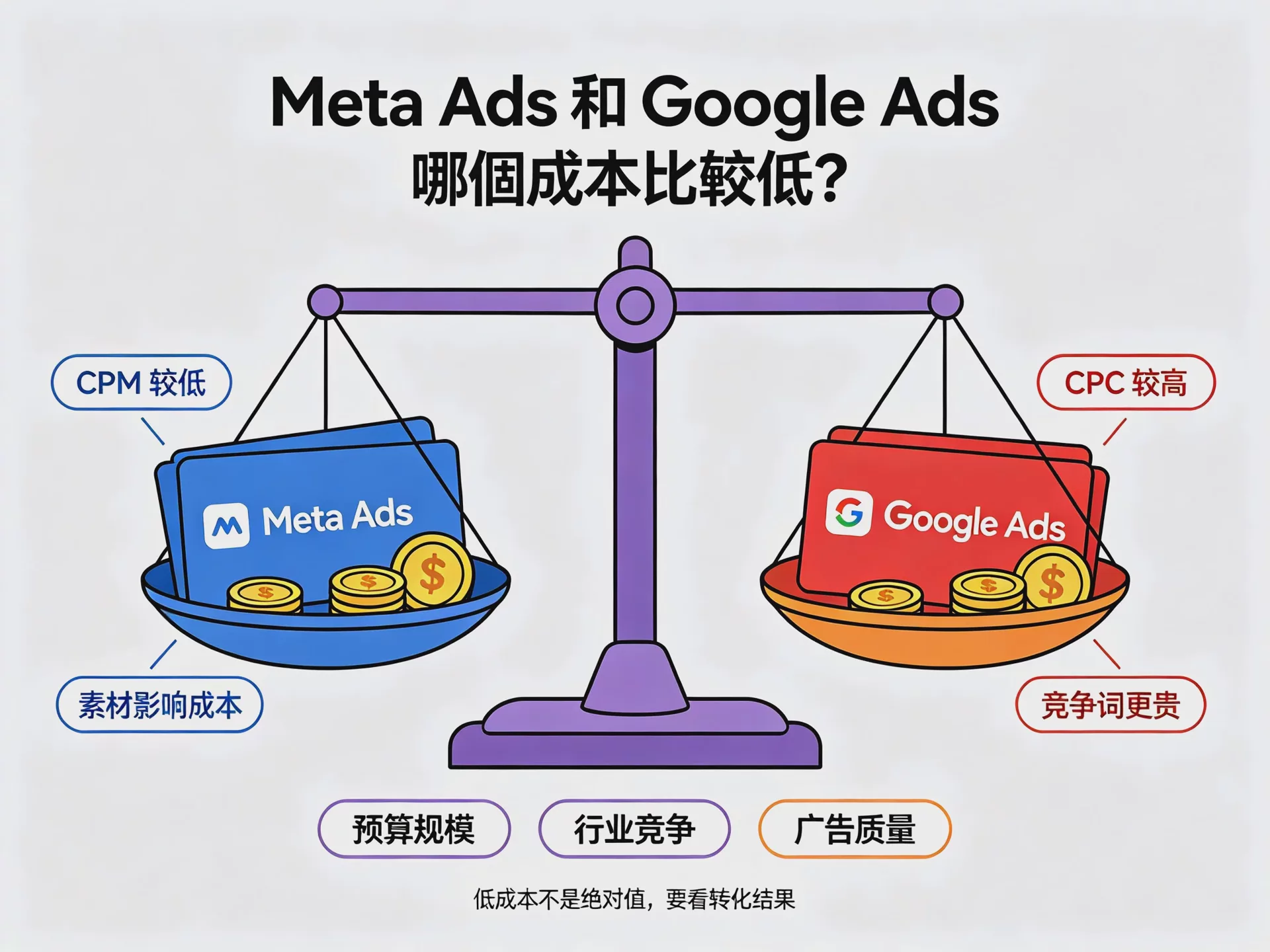
Meta Ads may have a lower cost per click, but a low CPC does not necessarily mean they will bring in more customers.
The cost per click on Google Ads may be higher, but because users have stronger search intent, the final conversion rate may be better.
Therefore, rather than simply comparing CPC, you should pay more attention to:
- CPA
- CPL
- ROAS
- Conversion Rate
- CAC
- Customer quality
The truly important question is not:
“Which platform has cheaper traffic?”
but rather:
“Which platform brings in more valuable customers?”
Can Meta Ads and Google Ads be run together?
The answer is:Yes, and for many businesses, combining the two is actually more effective.
That’s because the two platforms can cover different stages of the marketing funnel.
First stage: Meta Ads builds brand awareness
Proactively reach potential customers through Facebook, Instagram, and Reels.
Users may be discovering your brand for the first time through Meta ads.
Stage Two: Google Ads captures search demand
After users become interested in your brand or product, they may go on to search on Google:
- Brand name
- Product name
- Product Pricing
- Product Reviews
- Competitor Comparison
At this point, Google Ads can capture this high-intent traffic.
Stage Three: Increase Conversions Through Remarketing
For users who previously:
- Visited the website
- Viewed a product
- Clicked an ad
- Started registration
- Added items to their cart
But have not yet completed a conversion, conduct appropriate remarketing.
The entire process can be understood as:
Meta Ads creates demand → Google Ads captures demand → Remarketing increases conversions
Common mistakes in advertising campaigns in 2026
1. Choosing the wrong advertising platform
If your goal is to generate immediate conversions but you focus only on extensive reach campaigns, you may end up with a lot of traffic but very few conversions.
Conversely, if a brand has no awareness at all but relies solely on search advertising, it may also limit long-term growth.
Before launching a campaign, you should first confirm:
- Is your goal to build brand awareness?
- Do you need website traffic?
- Do you need to collect leads?
- Do you need immediate sales?
2. Looking only at CPC without considering conversion quality
Cheap traffic is not necessarily valuable.
Suppose the cost per click for Meta Ads is very low, but a large number of users enter the website without taking any action. In that case, even a lower CPC has no practical value.
Conversely, if the cost per click for Google Ads is higher, but users are more likely to register or make a purchase after visiting the website, the overall ROI may be better.
3. Conversion tracking has not been set up
Without tracking, it is difficult to know whether the ads are actually delivering results.
We recommend tracking:
- Website registrations
- Form submissions
- Product purchases
- Add-to-cart actions
- Downloads
- Inquiries
Complete conversion data not only makes manual analysis easier, but also helps advertising systems better understand which users are likely to convert.
How do you manage multiple Meta Ads and Google Ads accounts?
For a typical business, one ad account may be sufficient.
However, agencies, cross-border e-commerce teams, and multi-brand companies may need to manage multiple accounts and platforms simultaneously:
- Meta ad accounts
- Facebook Business Manager
- Google Ads accounts
- Google accounts
- Client website backends
As the number of accounts increases, team management also becomes more complex.
It is recommended to create a clear account management process, such as:
- Use separate work environments for different clients
- Create clear account categories
- Assign team permissions appropriately
- Avoid sharing account passwords among multiple people
- Maintain unified records of account operation procedures
For teams that need to manage a large number of accounts over the long term, tools with multi-environment management and team collaboration features can be used, such as P1 Browserto help teams distinguish between different work environments and make daily account management clearer.
P1 Browser can create different browser work environments, making it easier for teams to categorize and manage different businesses, clients, or work tasks.
However, it is important to note that no account management tool can replace platform policies. When using Meta Ads and Google Ads, you should still comply with the relevant platform guidelines to ensure that your advertising content and account operations meet policy requirements.

2026 Meta Ads vs Google Ads: Which Should You Choose?
Situations Where Google Ads Should Be Your Priority
- Your customers actively search for products
- You want to attract high-intent traffic
- You provide B2B or SaaS services
- Your product has a relatively high average order value
- You need to generate inquiries quickly
Situations Where Meta Ads Should Be Your Priority
- You need to build brand awareness
- Your product is well suited to visual or video presentation
- You want to quickly test different creative assets
- You need to reach more potential customers
- Want to create remarketing audiences
Suitable for cases where you want to run Meta Ads and Google Ads simultaneously
- Want to create a complete marketing funnel
- Pursuing both brand growth and sales
- Have a long-term advertising plan
- Want to test different traffic sources
- Do not want to rely too heavily on a single advertising platform
Conclusion
Meta Ads and Google Ads are not simply competitors; they are two different ways of acquiring traffic.
Google Ads excels at capturing existing demand, while Meta Ads is better at building brands, reaching potential customers, and creating new demand.
If your goal is to find users who are actively searching for products, Google Ads usually has the advantage; if you want to build brand influence through images, videos, and community content, Meta Ads is more worth testing first.
For businesses seeking long-term growth, the more effective strategy is usually not to rely on just one platform, but to combine them according to marketing objectives at different stages.
By using Meta Ads to create brand and market demand, then leveraging Google Ads to capture high-intent search traffic, and finally incorporating a comprehensive remarketing and conversion tracking strategy, you can create a more complete advertising process.
Advertising competition in 2026 is becoming increasingly intense. What truly matters is no longer simply choosing Meta Ads or Google Ads, but how to create a completeadvertising strategy, data tracking, creative testing, and account management process.
Frequently Asked Questions FAQ
Which is better, Meta Ads or Google Ads?
There is no absolute answer. Google Ads is suitable for capturing active search demand, while Meta Ads is suitable for brand exposure, content reach, and creating demand. The choice should be based on the product, audience, and marketing objectives.
When the budget is limited, should I invest in Meta Ads or Google Ads first?
If the product already has clear search demand, you can prioritize testing Google Ads. If the product needs to build market awareness through images and videos, you can prioritize testing Meta Ads.
Is Meta Ads suitable for e-commerce?
Yes. It is particularly suitable for fashion, beauty, home, and lifestyle products, which can be showcased through images, videos, and Reels. However, you can also combine it with Google Ads to capture active search traffic.
Can Meta Ads and Google Ads be run at the same time?
Yes. Meta Ads can build brand awareness and generate demand, while Google Ads can capture high-intent search traffic. Used together, they can cover a more complete marketing funnel.
Should you focus on CPC or ROAS when running ads?
You shouldn’t look at CPC alone. CPA, ROAS, conversion rate, and customer quality are more important. A lower cost per click doesn’t necessarily mean better overall ad performance.