


For YouTube operators, sustained growth does not just rely on publishing more videos.
Truly mature YouTube operations are not about judging 'what content might go viral' by feel, but about using data to identify which content is worth continuing to invest in, which users are more likely to convert, and which aspects affect video performance.
This article will introduce the 5 most important data metrics in YouTube operations and further break down environment management strategies in multi-account operation scenarios, helping you build a complete growth system from data analysis to execution and implementation.
Many creators encounter similar questions:
- Why do video views fluctuate so much?
- Why do some videos get good clicks but have very low watch time?
- Why is subscriber growth still slow after the channel has been updated for some time?
Behind these problems, it is often not a matter of content quantity, but a lack of systematic analysis of operational data.
The YouTube platform itself provides a complete data analysis tool, YouTube Studio, which includes important information such as user click behavior, viewing habits, traffic sources, and channel growth trends.
Why Must YouTube Operations Focus on Data Analysis?
Many beginners, when running a channel, usually rely on experience to determine content direction. For example:
- If they think a topic is popular, they immediately make a video;
- If they see a competitor with high view counts, they copy similar content;
- If they think a thumbnail design is attractive, they directly adopt a similar style.
But in actual operations, user feedback often differs from creators' expectations.
A carefully produced video may have a low click-through rate because its title is not attractive enough; a seemingly ordinary video may also receive a large number of recommendations because it precisely meets user needs.
The YouTube recommendation mechanism takes multiple factors into comprehensive consideration, including user click behavior, watch time, engagement, and the degree of content matching.
Therefore, operators need to use data analysis to find the key factors affecting growth, rather than simply relying on feelings to adjust content.
II. Core Metric 1: Click-Through Rate (CTR) — determining whether users are willing to open a video
Click-through rate (Click Through Rate) represents the proportion of users who click after seeing a video impression.
Calculation method:Click-through rate = video clicks ÷ video impressions
For YouTube, click-through rate is mainly affected by two factors:Video titleandVideo thumbnail.
If a video has many impressions but a consistently low click-through rate, it usually indicates that the title or thumbnail has not effectively attracted the target users.
Example comparison
Similarly, for content aimed at Amazon sellers:
- Title A:How Amazon Sellers Can Increase Sales
- Title B:I Tested 100 Amazon Accounts and Found the Real Reason Sales Are Declining
Although the latter conveys similar information, it creates stronger click motivation through specific scenarios and numbers.
When optimizing click-through rate, you should not simply pursue exaggerated titles; instead, you should ensure:
- The title promise matches the video content;
- The thumbnail can quickly convey the core message;
- Users receive the expected value after clicking.
Otherwise, even if the click-through rate increases, a decline in watch time may affect subsequent recommendations.
III. Core Metric 2: Watch Time and Audience Retention — Determines Whether the Algorithm Continues to Recommend
Many operators believe that view count is the core metric for measuring video success. But for YouTube, view count is only an outcome; the platform focuses more on user behavior after viewing.
The most important data points include:
- Watch Time: the cumulative amount of time users spend watching the video
- Audience Retention: how users drop off at different stages of the video
How to interpret the retention curve?
- If a large number of users leave in the first 30 seconds, it means the opening failed to quickly build interest in watching;
- If there is a noticeable drop at a certain point in the middle, it may indicate that the content pacing is dragging;
- If retention remains relatively high at the end, it means the content structure is fairly complete.
Therefore, when optimizing a video, you should not focus only on view counts, but should analyze:
- Why do users stay?
- Why do users leave?
- Which part truly creates value?
Four, Core Metric 3: Engagement Data — Judging Users' Genuine Participation with Content
Besides viewing behavior, user engagement is also an important indicator for judging content quality. It mainly includes:
- Number of likes
- Number of comments
- Number of shares
- Saving behavior
Videos with a relatively high engagement rate usually indicate that users not only watched the content but also engaged further.
Scenario Example
A cross-border operations channel publishes "5 Mistakes Amazon Beginners Are Most Likely to Make," and if the comment section is flooded with:
- "I ran into this problem too"
- "I hope you keep updating this series"
This shows that the content truly triggered user demand. Operators can identify topic directions for the next stage through the comment content.
Many excellent channels do not plan all their content in advance; instead, they continually find new content opportunities through user feedback. For example, some leading tech review channels create a "Viewer Q&A" series based on frequently asked questions in the comments, and the engagement rate of such videos is often 2-3 times that of regular videos.
V. Core Metric 4: Subscription Conversion Rate — Determining Whether Content Has Long-Term Value
Views can bring exposure, but only subscriptions can build long-term user assets.
Subscription conversion rate helps operators determine whether users are willing to continue following the channel after watching a video. Generally, a YouTube channel's subscription conversion rate in the 1%-3% range is normal, and high-quality content can reach over 5%.
If a video has a very high view count but very few new subscriptions, it may indicate that:
- The content solved a one-time problem but did not establish channel value.
Three Directions for Improving Subscription Conversion Rate
First, establish clear channel positioning.
Users need to know: if they follow this channel, what content can they still get in the future.
Second, create series-based content.
For example: Amazon product selection series, TikTok operations series, YouTube growth series. Continuous content makes it easier to build user expectations.
Third, guide naturally in the video.
Rather than simply reminding users to "remember to subscribe," it is more effective to tell them what question the next episode will continue to analyze, giving them a "reason to stay."
Core Metric 5: Traffic Sources — Determining Channel Growth Direction
YouTube traffic mainly comes from the following channels:
- Recommended videos: Algorithm-driven recommendations
- YouTube search: Users actively search
- Browse feature: Homepage recommendation feed
- External traffic: Traffic from other platforms
- Channel homepage: Users actively visit
Different sources represent different growth models:
- High search traffic: This indicates that users are actively looking for your content, and that your SEO optimization is effective;
- High recommendation traffic: This indicates that the algorithm is expanding content exposure;
- High external traffic: This indicates that other platforms are helping drive traffic.
Operators need to regularly analyze the traffic structure and determine what stage the channel is currently in:
- Early stage of a new channel: You can acquire targeted users through search keywords;
- After content has accumulated: Need to improve video quality so the algorithm increases recommendations.
Seven. From Data to Execution: Environment Management for Multi-Account YouTube Operations
Once you have used the above data analysis to determine a multi-market, multi-account operations strategy, the next challenge you face is at the execution level—How can you efficiently manage the operating environments of multiple accounts?
For individual creators, analyzing the data of one channel is already complex enough. But for cross-border businesses and content teams, they usually operate multiple YouTube accounts at the same time:
- Accounts for different country markets
- Accounts for different brands
- Accounts for different content directions
At this point, analyzing data from a single video is no longer enough. Teams also need to pay attention to:
- Growth trends of different accounts
- Content performance in different markets
- Operational efficiency across accounts
Example Scenarios
- U.S. market accounts mainly publish product review content;
- European market accounts experiment with tutorial-style content;
- Asian market accounts explore short-video content.
By comparing data from different accounts, you can identify content strategies that are better suited to the target market.
Core Risk of Multi-Account Operations: Environment Association
However, multi-account operations face an easily overlooked problem:Environment Association Risk.
If different accounts use the same device environment, browser parameters, or login information over the long term, they may trigger the platform's association detection, leading to account throttling or even bans. This risk is especially prominent in the following scenarios:
- Multi-Region Operations
- Multi-Person Team Collaboration
- Managing multiple brand accounts
- Testing different content directions
In these scenarios, maintaining an independent operating environment for each account is the foundation for ensuring account security.
P1 Fingerprint Browser: Building Independent Environments for Multi-Account Operations
P1 Fingerprint Browser (P1Browser)It can help teams create an independent browsing environment for each YouTube account, addressing environment association issues at a fundamental level.
In YouTube multi-account operation scenarios, P1 can provide the following support:
Environment Isolation
Each browser window has independent cookies, local storage, and configuration profiles that are not shared with one another, fundamentally blocking the risk of account environment association.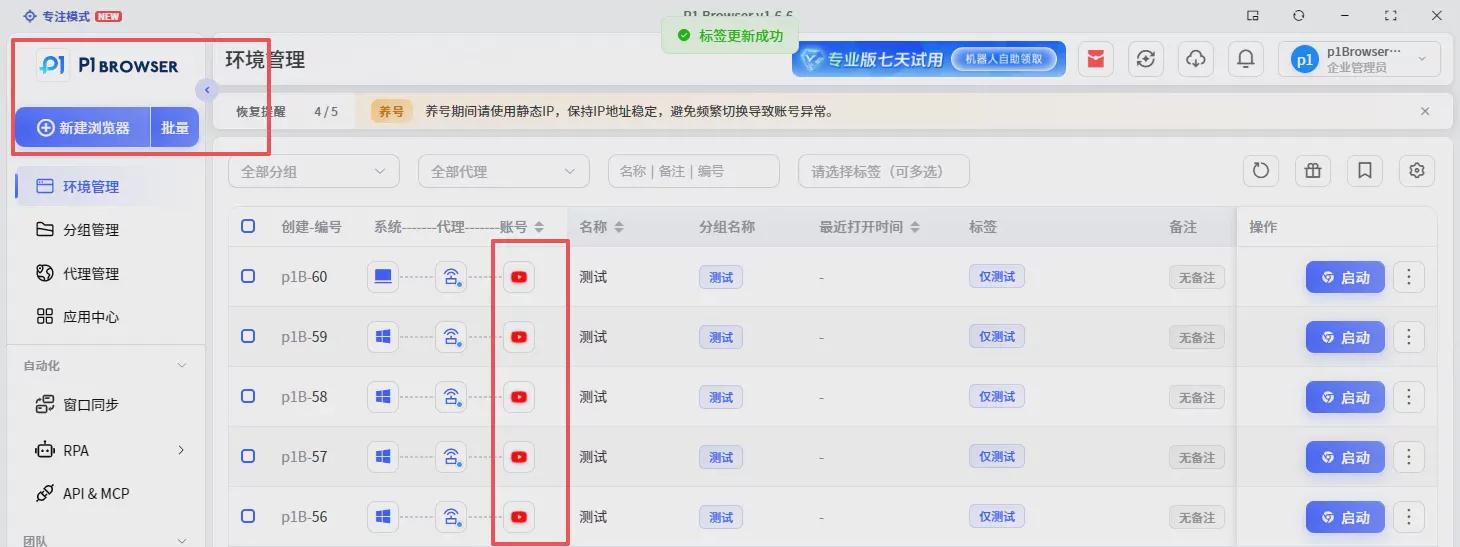
Fingerprint Parameter Configuration
Supports visual configuration of browser fingerprint parameters such as language, time zone, resolution, WebGL, etc. For example, operations teams can configure an English + Los Angeles time zone environment for U.S. market accounts and a Japanese + Tokyo time zone environment for Japanese market accounts; each environment runs independently without interfering with the others.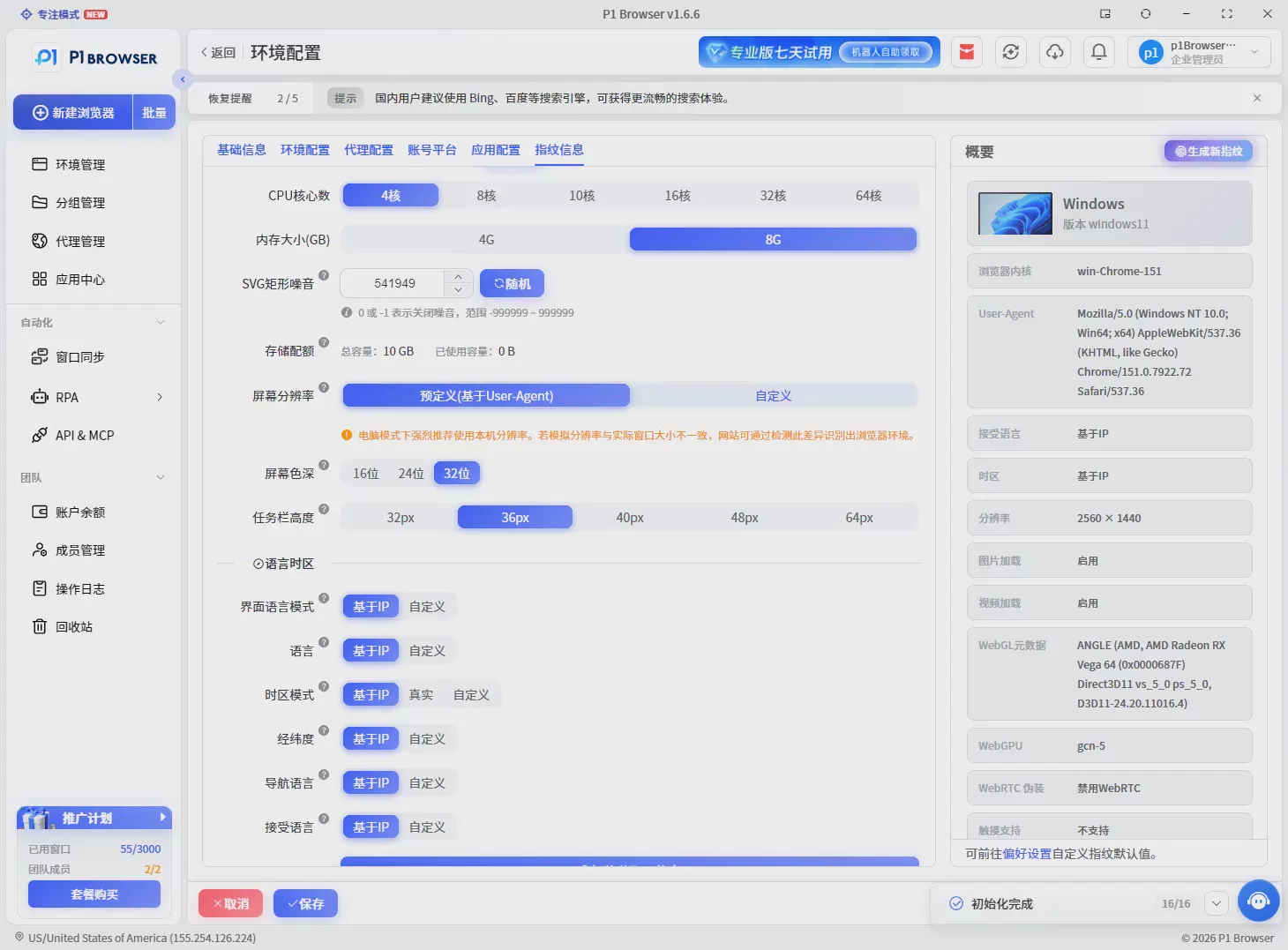
Proxy Binding
Compatible with mainstream proxy protocols and supports binding different network egresses per window, enabling precise matching between accounts and IPs.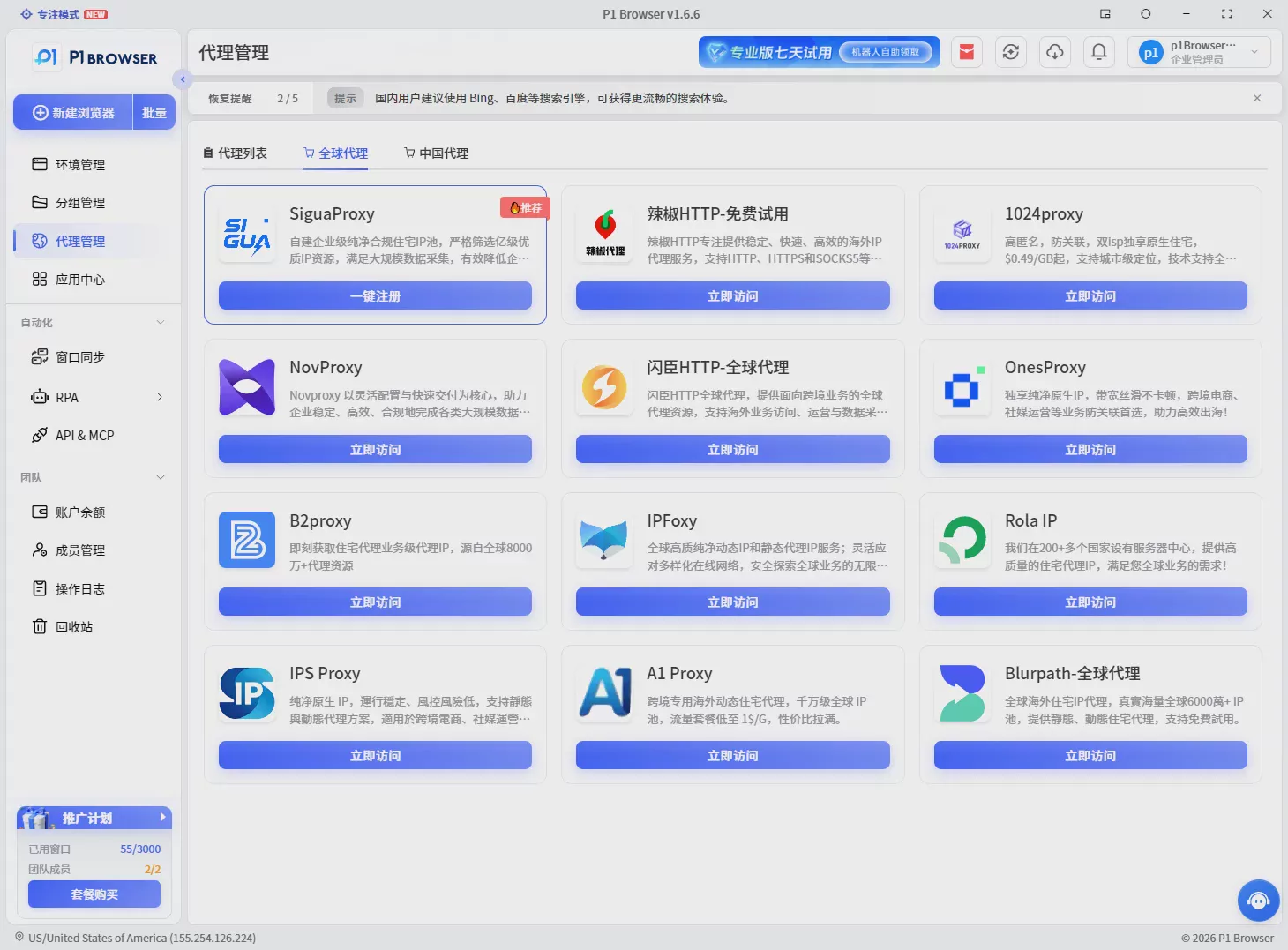
Team Collaboration
Built-in member grouping and hierarchical permission management, supporting environment profile and resource sharing. In an operations team, content creators can focus on video uploads and data analysis, while administrators can centrally manage account permissions, making account division of labor clearer and permissions more controllable.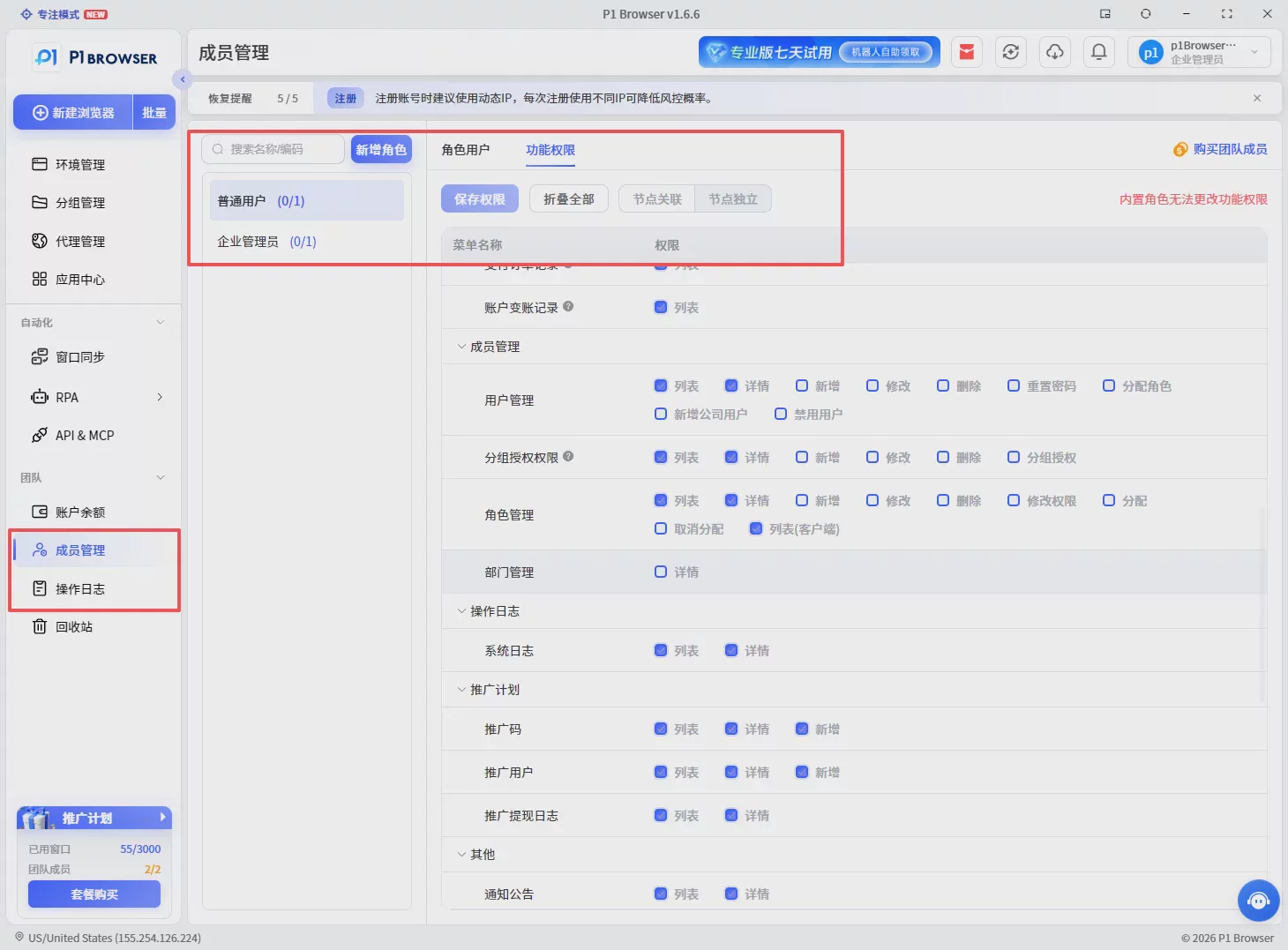
VIII. How to Establish a YouTube Data Analysis Process?
A complete data review process usually includes:
First step: review the channel's overall data every week.Analyze views, watch time, and subscriber trends.
Step two: Analyze top-performing videos.See which titles, thumbnails, and content structures drive higher clicks and retention.
Third step: analyze underperforming videos.Identify where viewers drop off and determine whether the problem lies in topic selection, packaging, or content structure.
Step Four: Create a content optimization record.With long-term accumulation, you can build your own content database.
The value of data analysis is not in explaining the past, but in helping operators predict the future.
Summary: Data-driven + tool-empowered to achieve sustained YouTube growth
Running a YouTube channel is not simply about publishing videos. Channels that can truly achieve sustained growth are constantly adjusting their content strategies through data:
- Click-through ratedetermines whether users open the video;
- Watch timedetermines whether the content is worth recommending;
- Engagement datareflects the degree of user recognition;
- Subscription conversiondetermines long-term value;
- Traffic sourcesdetermines the direction of growth.
For individual creators, establishing a data analysis system enables them to gradually shift from "publishing content" to "operating a channel."
For enterprise teams, in multi-account, multi-market operations, in addition to data-driven content optimization, they also need professional tools to ensure the security of the account environment.
P1 fingerprint browser can build an independent, stable operating environment for each account, while improving multi-account management efficiency through team collaboration features, making YouTube matrix operations safer and more efficient.
If you are also operating multiple YouTube accounts and want to configure an independent, stable browsing environment for each account
Go to P1 fingerprint browser official website (www.p1go.com) to learn more