



The Second Store Was Shut Down Before Any Talk of Expansion
A seller in Guangzhou specializing in women's clothing on Temu had three stores running steadily until one day the platform issued a notification: Store A was terminated for "association with multiple accounts." The problem traced back to the office computer—all three stores shared the same Chrome browser. Although separate Profiles were set up, the registration documents came from the same business license, and the login IP remained consistent throughout. The review team confirmed the association in just three days; Stores B and C were then subjected to linked restrictions, and all were ultimately shut down.
This is not the platform arbitrarily picking on sellers; it is risk-control rules triggering a multi-signal stacked determination. More stores does not mean more risk, but incomplete isolation almost guarantees a violation. Once a single store is up and running, the first step toward multi-store expansion is not registering another store but understanding exactly what Temu is detecting and where your isolation configuration is falling short.
Don't Rush to Open a Second Store: Where Are the Risk-Control Red Lines for Temu Multi-Store Operations
Temu's official position is to reject by default any multi-store ownership under a single entity, though individual cases (such as different legal persons or different business licenses) may leave room for multiple stores. The risk-control logic revolves around three signal layers: the document layer, the device layer, and the network layer. The moment two of these layers show overlap, the probability of account association rises significantly.
The document layer is the highest-threshold and most error-prone component. Registering multiple stores under the same business license, mixing identity information among family members, or binding the same receiving account to multiple accounts will all trigger the platform's cross-referencing. During Temu's review, the consistency of the legal representative's ID, business license, corporate bank account, and receiving account is verified. A duplicate in any single item can result in outright rejection at the document review stage or may be caught during the operational phase through backend data cross-referencing.
Association signals at the device and network layers are more covert. Standard browser cookies and local storage are not cleanly isolated by Profiles. When the same device logs into multiple accounts, parameters in the browser fingerprint such as Canvas, WebGL, and font lists may retain consistent characteristics.Browser Isolation SolutionThe core logic is to isolate these parameters one by one so that the "self" presented to each store does not interfere with the others. High-frequency account switching under the same IP, especially overly frequent switching of dynamic residential IPs, can also trigger abnormal login detection.
Key Assessment: Temu's account-association detection is not triggered by a single signal but by multiple overlapping signals. Isolation at a single point (for example, changing only the IP) is insufficient to establish a security boundary. All three layers—documents, devices, and network—must be configured independently.
Cross-check This Document Checklist Before Opening a Store
The first step in multi-store expansion is material preparation. The documents required for each store are not "multiple copies of the same thing" but "completely independent." Below is the checklist of materials that must be prepared item by item:
- Business License: Each store corresponds to one independent business license. The legal representative's name and the Unified Social Credit Code must not be duplicated. Different licenses under the same legal representative are also not recommended, as the platform can check industrial and commercial associations.
- Legal Representative's ID Card: Must match the legal representative on the business license. Clear photos of both the front and back sides are required, with no alterations.
- Bank Account: Store A uses corporate account X, Store B uses corporate account Y; there must be no association between the two. For personal stores, use personal bank cards belonging to different legal representatives.
- Contact Information: The phone number and email used for shop registration must each be independent; the same phone number must not be used to register multiple seller accounts.
- Shop Entity Information: The company name, registered address, and contact person details must not be duplicated or highly similar to those of other shops.
Once all documents are prepared, the order of operations that follows determines the level of risk. Getting the order wrong—for example, logging into the first shop on the same computer and then switching to new materials to open a second shop—actually makes it easier to leave traces of association.
Compliant Path: A Three-Step Process for Expanding from One Shop to Multiple Shops
- Isolate the Environment First, Register Afterward: Create a new independent environment in P1Browser for the second shop, configure a separate device fingerprint and proxy IP, and only after completing environment calibration, proceed to the Temu registration page. Do not open the registration link directly in a browser that already has an existing shop logged in.
- Complete Registration and Verification in Order: Using the new environment, open the Temu Seller Center and use an independent business license, legal representative ID, and bank account, following the standard registration process to complete the account registration. Throughout the entire login and authentication process, do not switch IPs or reset the browser fingerprint.
- Maintain low activity during the isolation verification period: After completing new store registration, maintain a normal but low-frequency operational pace for the first 30 days. Avoid bulk listings, frequent profile modifications, or cross-store operations in a short period, allowing the platform to complete its credit accumulation cycle normally.
The core logic of the three-step process is: isolate the environment first, then onboard the business. The data layer, device layer, and network layer must be fully configured before registration, not patched up afterward.
How P1Browser Solves the Core Problem of Multi-Store Association
In Temu multi-store operations, the most commonly confused distinction is the gap between "opening multiple browser windows" and "achieving full environment isolation." Opening multiple Profiles in a standard browser only isolates Cookies and partial local storage, while device-layer parameters such as Canvas fingerprint, WebGL rendering parameters, font lists, time zone, and screen resolution remain identical. These parameters collectively form each account's "device fingerprint," which platforms use to determine whether accounts share a common origin.
P1Browser establishes isolation across three dimensions: the device fingerprint layer independently simulates different operating systems, browser versions, Canvas values, WebGL values, and font lists, ensuring each store environment presents entirely distinct device characteristics at the code level; the network layer assigns a dedicated proxy IP to each account, preventing multiple accounts from logging in under the same IP;Cookie and Storage Isolationensures that session data does not interfere across accounts, preventing third-party identification technologies from tracking cross-account behavior.
In practical configuration, a common mistake is changing only the IP without updating the fingerprint, or changing only the browser fingerprint while the proxy IP belongs to the same subnet. The effectiveness of isolation depends on the independence of parameters across all layers, not on changes in a single dimension.
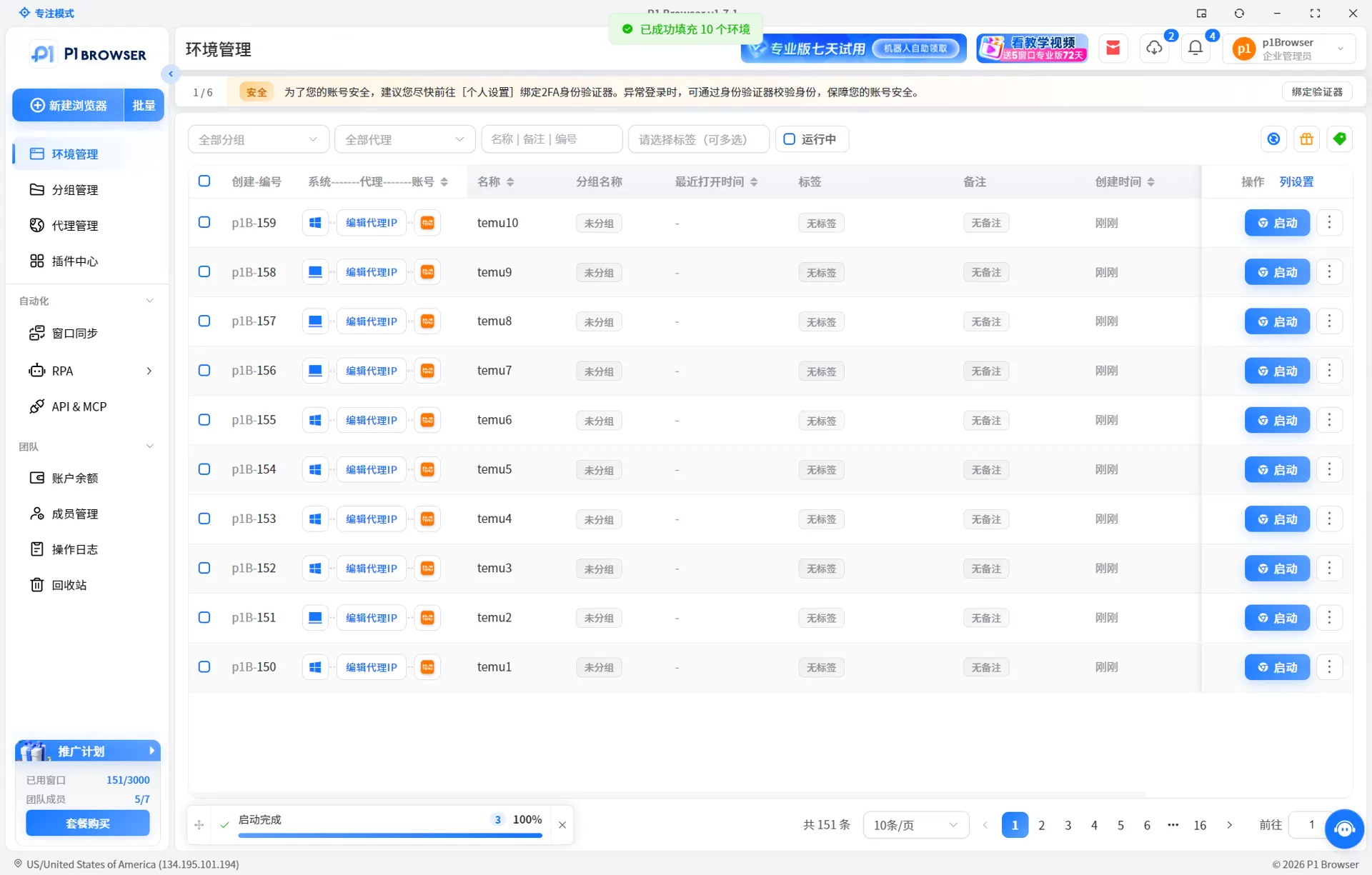
For sellers with existing operational experience, multi-store management efficiency is often harder to balance than single-store isolation.Efficient Multi-Store ManagementThe core contradiction is the conflict between isolation security and operational efficiency—dedicating one environment per account drives up management costs, while sharing an environment increases association risk. P1Browser's batch operation feature allows parallel management of multiple independent environments within a single panel, reducing switching costs while maintaining isolation boundaries.
Frequently Asked Questions
Frequently Asked Questions
Can I open two Temu stores on the same computer?
Technically, yes, but you must create a completely isolated environment for each store in a professional fingerprint browser. Running multiple instances of a regular browser or sharing the same browser to log into different stores carries an extremely high risk of association.
Can I register two Temu stores with the same business license?
No. Temu verifies the uniqueness of business licenses during its review process. Registering multiple stores with the same license will be rejected at the document review stage, or the association may be detected later through backend data comparison.
Do proxy IPs and fingerprint browsers have to be configured together?
Yes. Single-layer isolation (changing only the IP or only the fingerprint) is not sufficient to establish a security boundary. Both layers of signals must be independent simultaneously to effectively reduce the probability of association.
How long after registering a new store can it operate normally?
After registration is complete, it is recommended to maintain a low-frequency operational pace for the first 30 days to avoid triggering risk-control re-review through a large number of short-term operations. After 3 months of stable operations, account credit will have accumulated, providing greater room for tolerance when expanding to a second or third store later.
I've already opened multiple Temu stores using a regular browser. Is it still in time to make changes now?
It is still in time, but environment isolation needs to be completed as soon as possible. Migrate to a new fingerprint browser environment, configure an independent IP and device fingerprint for each existing store, and stop operating new stores in the old environment. Historical association traces in the old environment cannot be eliminated, so it should be fully isolated going forward.