



When the number of accounts grows from a few to dozens, many teams find that the real challenge is not logging into accounts, but how to manage the browser environments corresponding to these accounts over the long term.
For multi-account businesses such as cross-border e-commerce, overseas social media operations, and ad placement, each account generates a large amount of browser data, including cookies, login status, local storage, browser configurations, and device environment parameters.
If multiple accounts run in the same or disorganized browser environment over the long term, it not only increases team management costs but may also increase the association risk caused by overlapping account environments.
When choosing a fingerprint browser, there are three core aspects to focus on:
- Environment isolation capability: whether the browsing environments of different accounts can be managed independently;
- Environment stability: Whether the environment is reliable during long-term operation;
- Team collaboration capabilities: Whether it is convenient to allocate and maintain when multiple people are operating.
In addition, browser engine updates, product maintenance capabilities, and long-term usage costs are also important factors to consider when choosing a tool.
Why does multi-account operation increasingly require environment management?
In the early days of account operation, one account usually corresponded to one computer, one browser, and one login environment. For individual users or those with a small number of accounts, this approach was fully sufficient.
As the business grows, many teams begin to simultaneously operate multiple cross-border e-commerce stores, multiple overseas social media accounts, multiple advertising accounts, as well as business environments managed by multiple members.
At this point, the problem gradually changes—at first the focus was on "how to log in to more accounts," and later it gradually became "how to manage the browser environments corresponding to different accounts over the long term."
Because each account generates its own environment data during operation:Cookie and login status, website data such as Local Storage, browser configuration, browser fingerprint-related parameters, and network environment information.
If these environments are not clearly managed, teams are likely to encounter the following problems:
- Not knowing which environment corresponds to which account;
- Duplicate operations among team members;
- Unable to quickly recover after switching devices;
- Environments are mixed across multiple accounts.
For long-term operations teams, establishing a clear browser environment management system has become an important part of account management.
II. Why does multi-account operations need to focus on anti-association?
Many users think account management is mainly about saving account passwords.
In reality, when platforms identify access environments, they usually consider multiple factors, including account information, network environment, browser data, device environment characteristics, and user operation behavior.
Cookies, cache, browser parameters, and device characteristics in the browser environment together form the daily operating environment of an account.
Therefore, the key in multi-account operations is not just "whether an account can be opened," but whether different accounts have clear, independent, and manageable operating environments.
A reasonable environment management approach can help teams reduce data crossover between different accounts and improve standardization in multi-account operations.
It is important to note that no tool can replace compliant operations. Long-term stable account operation still requires comprehensive management based on platform rules, business processes, and operating methods.
III. Why is Chrome Profile not necessarily suitable for managing large numbers of accounts?
Chrome Profile is the earliest multi-account management method adopted by many users.
Its advantages are obvious: free, simple to use, able to save different Cookies, and able to distinguish different login states. For a small number of accounts, Chrome Profile can fully meet basic needs.
But as the number of accounts increases, problems gradually appear.
1. Increased Environment Management Costs
When there are only a few accounts, you can distinguish them by name (for example, Amazon-US-01, Amazon-US-02). But when the number of accounts increases to dozens or even more, you need to additionally maintain which Profile corresponds to which account, which member is responsible for which environment, which environments are in use, and whether environment configurations have changed. Management costs will continue to rise.
2. Profile Primarily Isolates Data, but Is Not Equivalent to Complete Environment Management
Chrome Profile mainly addresses Cookie isolation, browsing history isolation, and login state isolation. However, the browser's underlying environment is still shared in some cases, such as the operating system environment, browser kernel version, GPU-related parameters, Canvas/WebGL rendering characteristics, and system font environment. Therefore, Chrome Profile is more suitable for simple data isolation, while professional environment management tools focus more on the creation, maintenance, and management of a complete browser environment.
When the number of accounts reaches a certain scale, many teams will upgrade from Chrome Profile management to professional environment management tools, such as P1 fingerprint browser.
Fourth: What Capabilities Should You Consider When Choosing a Fingerprint Browser?
When many users choose a fingerprint browser, they first focus on how many environments can be created, how many accounts are supported, and how much the software costs.
These factors are certainly important, but for long-term operations, you should pay more attention to the following aspects.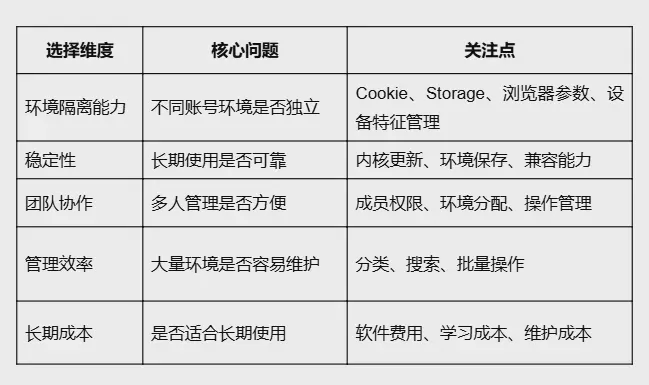
Five. How Does P1 Fingerprint Browser Help Manage Multi-Account Environments?
P1 Fingerprint Browser is mainly designed for multi-account operation scenarios. Through independent browsing environment creation, environment parameter management, and team collaboration capabilities, it helps users establish a more standardized account environment management process.
1. Independent Browsing Environment Management
Different accounts can correspond to different browsing environments. Users can create independent environments based on business needs and manage login data, browser configurations, environment parameters, and usage permissions by category. This reduces data confusion between different accounts and establishes a clear correspondence between accounts and environments.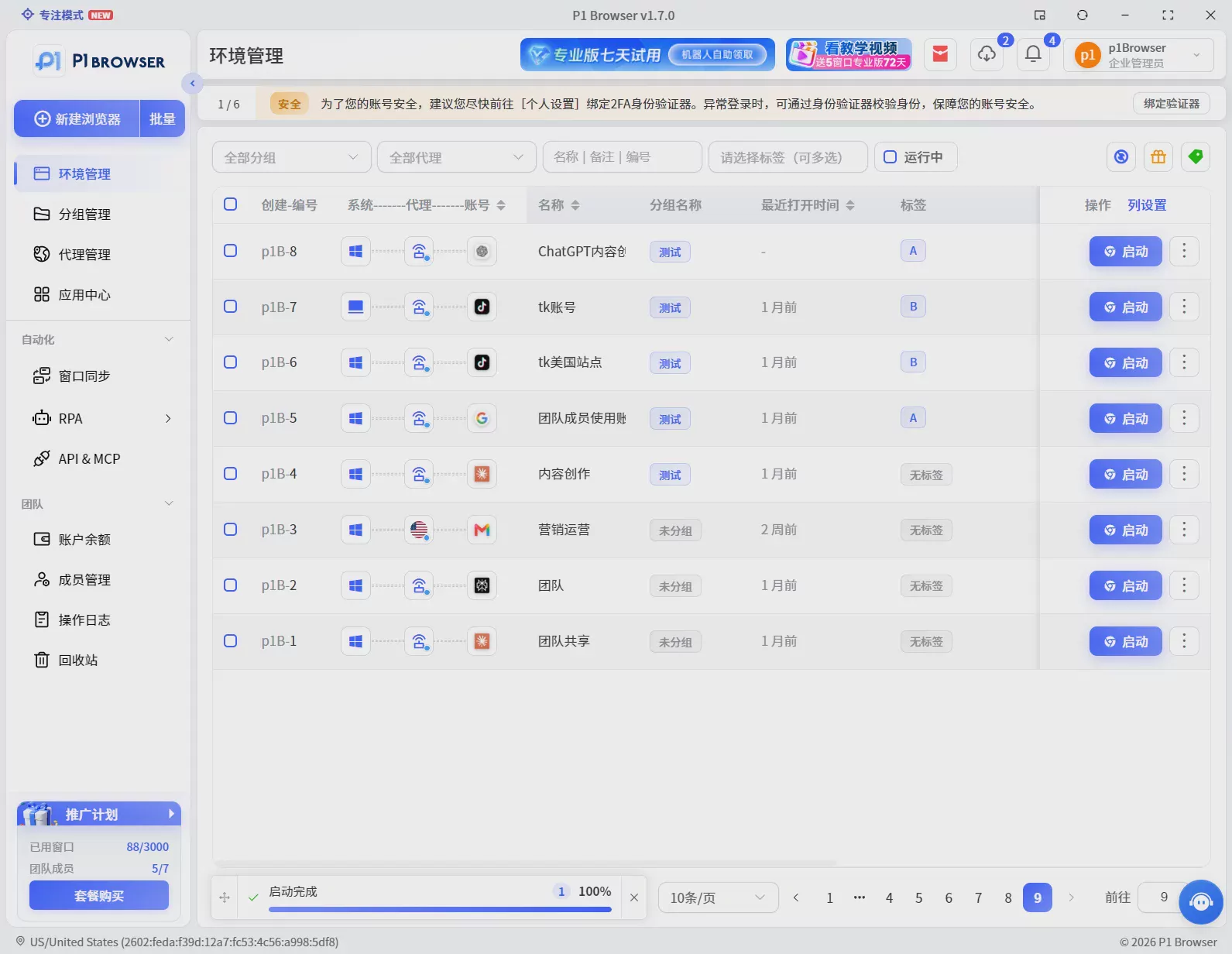
2. Environment Parameter Management, Reducing Environment Overlap
During multi-account operations, browser environment parameters are also an important part that requires attention. P1 supports the management of browser environment-related parameters, including User-Agent, language settings, time zone configuration, Canvas/WebGL-related environment parameters, and browser configurations, helping teams establish a clearer environment management system.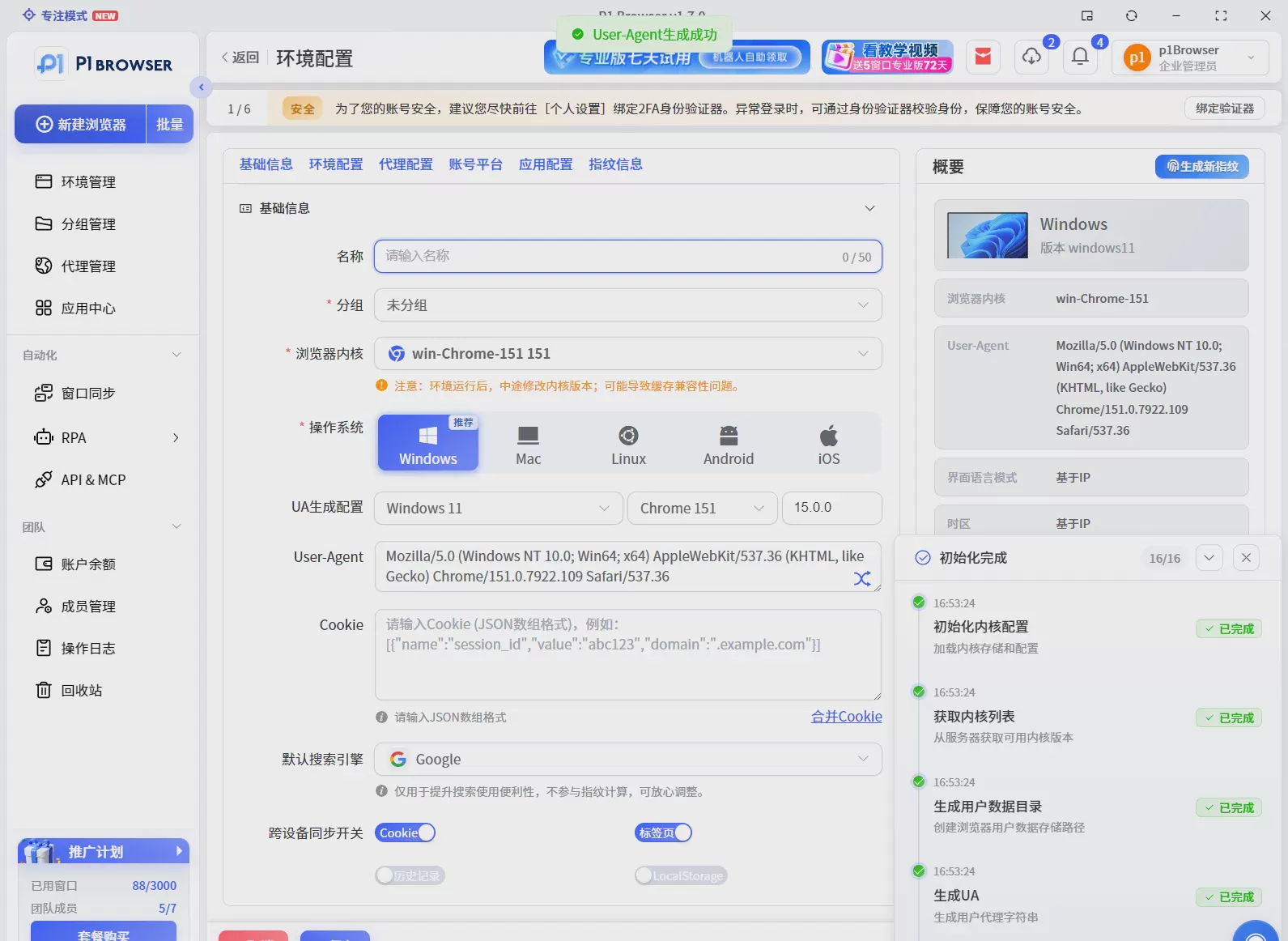
3. Multi-User Collaboration, Improving Team Management Efficiency
As the number of accounts increases, the biggest challenge is not creating environments, but managing them. P1 supports environment classification, member management, permission allocation, and team collaboration, enabling different members to manage the corresponding environments according to their business roles and reducing communication costs and operational errors.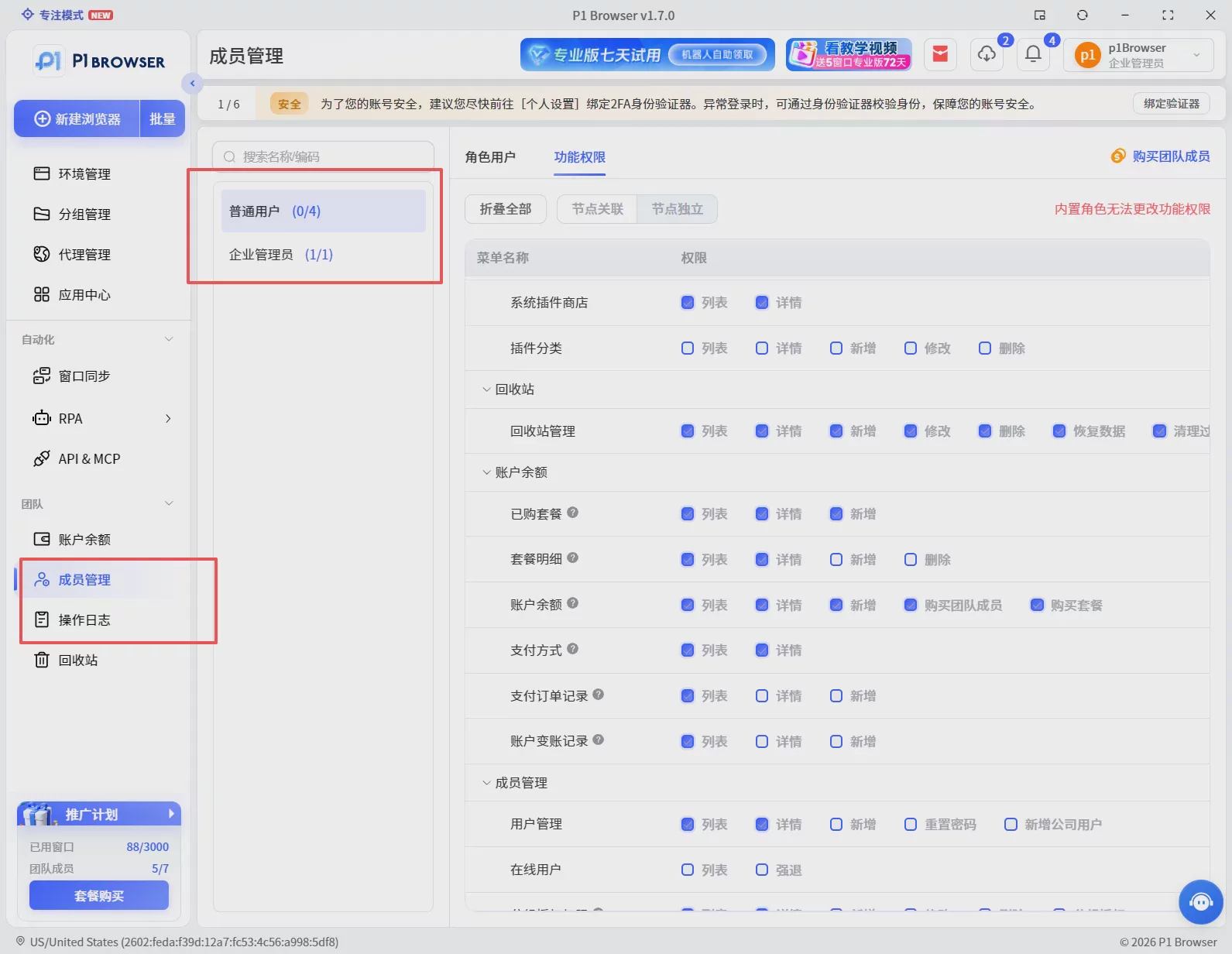
Six. How Should Teams of Different Sizes Choose?
Not all users need professional environment management tools.
Individual Users
If you only have a small number of accounts and operate alone, a regular browser may already meet your needs. Focus on ease of use, convenient environment management, and controllable costs.
Small Teams
If you begin collaborating with multiple people, you need to focus on environment allocation, account mapping, and basic permission management.
Medium and Large Teams
As the number of accounts continues to grow, you need to focus on batch environment management, member permission control, long-term maintenance efficiency, and product stability. For such teams, the value of the tool is not only in creating more browser environments, but more importantly in establishing standardized management processes.
Seven. Don't Choose a Fingerprint Browser Based Only on Price
Different products vary in functional design and applicable scenarios. When choosing, it is recommended to consider the following aspects.
Current needs
How many accounts do you need to manage at present? Will the number of accounts grow in the next six months or one year? Do you operate multiple platforms simultaneously? These factors will all affect your choice of tool.
Team size
Is it individual operation or multi-person collaboration? Do you need permission management? Do you need unified environment maintenance? The larger the team, the higher the requirements for management capabilities.
Long-term usage costs
In addition to the software price, you also need to consider learning costs, management costs, product maintenance capabilities, and technical support capabilities. A stable, easy-to-manage environment tool can reduce operational complexity in the long run.
Summary
With the development of cross-border e-commerce and overseas business, multi-account operations have become an increasingly common model. From initially managing account passwords to later managing complete browser environments, this is a change that many teams will experience.
Chrome Profile can address basic account categorization needs, but when the number of accounts increases and teams begin collaborative operations, relying solely on browser profiles may make it difficult to meet long-term management needs. The core value of fingerprint browsers is not just creating multiple browser windows, but helping teams establish a clearer, more independent, and more maintainable browser environment management system.
P1 Fingerprint BrowserThrough independent environment creation, browser parameter management, and team collaboration capabilities, it helps multi-account operations teams reduce environment management complexity and improve overall operational efficiency. If you are moving from single-account operations to the multi-account, multi-team collaboration stage, you can start by mapping the current relationships between accounts and environments, then gradually introduce professional environment management tools to establish a standardized multi-account management system.
Frequently Asked Questions (FAQ)
What is the difference between a fingerprint browser and a Chrome Profile?
Chrome Profile mainly addresses browser data isolation issues such as cookies and login status, while a fingerprint browser further focuses on browser environment parameter management, team collaboration, and maintenance of a large number of environments. For a small number of accounts, Chrome Profile is sufficient, but as the number of accounts increases, the advantages of professional environment management tools become more obvious.
Can a fingerprint browser prevent account association?
Fingerprint browsers are mainly used to help users create independent browsing environments and reduce environment overlap between different accounts. However, stable account operations also require comprehensive management in combination with platform rules, network environments, business information, and operational methods. No tool can replace compliant operations.
What scenarios is P1 Fingerprint Browser suitable for?
It is mainly suitable for scenarios that require multiple independent browsing environments, such as cross-border e-commerce multi-store management, overseas social media account operations, advertising account management, and multi-member team collaboration.
Are more fingerprint browser environments always better?
The number of environments is only a basic metric. For long-term operations, what matters more is environment stability, management efficiency, and team collaboration capabilities. Products that can create a large number of environments but lack sufficient stability will instead increase maintenance costs over the long term. It is recommended to prioritize environment quality and comprehensive management capabilities based on your own account scale and team needs.