


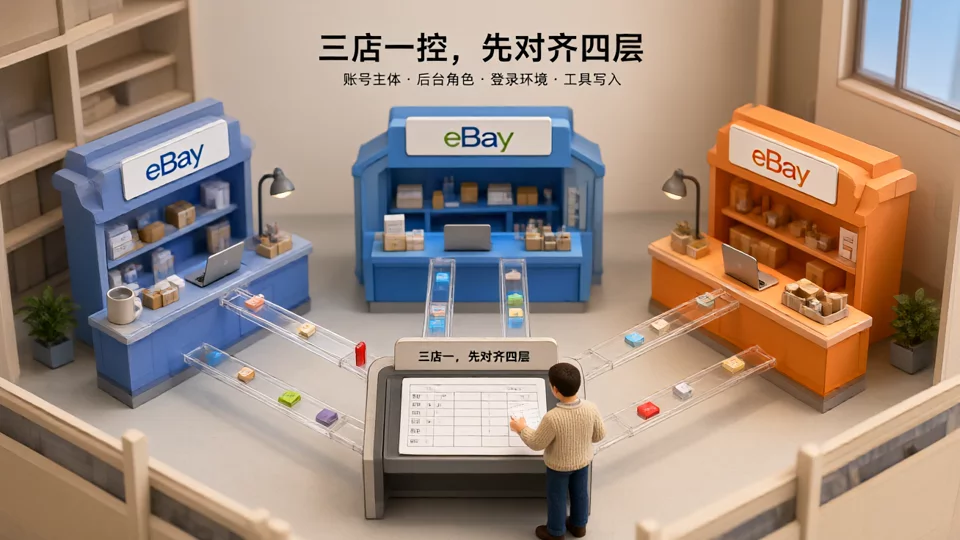
Three stores are set up on eBay, Walmart, and Etsy, and logging into each one individually works fine. However, once the same person uses the same set of Etsy store management tools to centrally adjust prices and respond to messages, the eBay backend begins frequently requesting secondary verification, Walmart orders are written into the Etsy store, and a colleague who left two months ago can still access the backend to change inventory.
These three phenomena may look like tool issues, but they actually stem from a mismatch between the account entities, backend roles, login environments, and tool write scopes of the three backends. This article does not compare which platform is better; it answers one question: given that you are already (or preparing to) use Etsy store management tools to manage stores uniformly, how should each layer of the eBay Seller Hub, Walmart Seller Hub, and Etsy backend align with the tools.
First distinguish the account entities of the three backends, then discuss how to integrate the tools
What determines whether the same business license can open a second store, or whether one backend can host multiple stores, is the platform's rules on account entities, not whether the tool supports it. Before integration, use three questions to clearly outline your store matrix.
- Who is the account entity:eBay's account entity is the seller account itself, with country-specific sites being operational facets under the account; Walmart audits based on the onboarding entity, and applying for a second account under the same entity usually requires a specific business justification, with approval depending on the platform's review results; Etsy's stores are tightly linked to the account, identity verification, and payment methods.
- How many stores are there under one entity: These three platforms do not follow a 'one backend, multiple shops' structure; multiple shops often mean multiple sets of identities. Whether Etsy allows the same entity to open a second shop should be verified against Etsy's official policy before registration. Do not plan based on the mindset of 'just opening a few more accounts.'
- Which site or country the shop belongs to: eBay operates one storefront per country site, and Walmart's sites are similarly independent. This directly determines how order and inventory mappings are handled downstream.
Different answers to these three questions require tools to connect at different layers. eBay and Walmart are shown side by side because they happen to represent two typical structures: one account with multiple sites, and one entity with one account. Teams expanding from eBay to Walmart, and adding Etsy are most likely to get stuck here. You can refer to the grouping approach for account entities atThe multi-platform account management approach from eBay, Walmart to Shopee and AliExpress.
eBay Seller Hub and Walmart Seller Center: Differences focus on roles and sites
When placing the two backends side by side, the differences are actually only in four areas, but each one changes the granularity of tool integration.
| Comparison dimension | eBay Seller Hub | Walmart Seller Center |
|---|---|---|
| Account entity and store setup | Seller accounts are the primary entities, with sites operating under these accounts; multiple stores typically correspond to multiple account sets | Onboarding reviews are based on the entity; one entity corresponds to one Seller Center account, and a second account requires a business explanation |
| Backend role divisions | Seller Hub allows adding team members and assigning permission scopes, focusing on functional-level access | Seller Center offers administrator and operational roles, with finance and operations separated |
| Site and inventory attribution | Listings are tied to specific sites, and inventory is managed by site dimension | Sites are independent, with inventory and prices maintained per site |
| Impact scope of account health | Account-level health status aggregates site performance under the same account | Performance metrics directly determine whether an account can continue selling |
| Impact on tool integrations | Multiple sites within the same account can share a single authorization, but site-level mapping is required. | One account, one authorization; cross-store operations imply cross-entity interactions and must be completely separated. |
The final column is critical: For eBay, multi-site shared accounts allow the tool to share a single set of authorizations, but orders and inventory must be mapped by site; For Walmart, each store corresponds to an independent authorization, and mixing them is equivalent to writing data from two entities into the same pool. The actual evaluation criteria for the Account Health row are based onthe seller policies and account status descriptions in the eBay Seller Center.as the reference.
Which layer should Etsy store management tools be connected to?
Etsy store management tools are not a "general backend." They can only write within the authorized scope, while the order, inventory, and message pathways in the eBay and Walmart backends correspond to different roles.
The most common misuse is treating the Etsy tool's order list as the sole entry point and casually modifying eBay prices or Walmart inventory within it. Such operations are either rejected by the platform API, resulting in synchronization failures; or, worse, the data is written but to the wrong store.
To judge if the tool is connected correctly, there is a simple standard: when a write operation fails, can you distinguish in the same interface whether it is due to insufficient permissions, mapping errors, or errors in the platform API itself? If these three causes are mixed into a single "synchronization failed" message, it indicates that the tool has only performed superficial integration and has not truly addressed the role and mapping layers. For tool selection and trial period acceptance items, refer toRecommended Multi-Store Management Tools: A Selection Checklist from Inventory Synchronization and Permissions to Reporting..
Draw the four-layer corresponding relationships into a single table

Write one store per column and one corresponding item per row: who the account owner is, which backend roles exist, which login environment is used, and which layer the tools can write to. If any cell is left blank, it will become the source of a future failure.
To give a concrete example: if the operations role for the eBay US site, the administrator for the Walmart store, and the owner account for the Etsy shop are all registered under the same person's name, logged in via the same browser, and share a single authorization within the tools, then frequent CAPTCHAs are not "accidental" but the inevitable result of this structure. Conversely, as long as the four layers are separated in the table, even if the tool itself only performs at eighty percent, failures can be contained to a single store.
How to structure the division of labor for multi-account operations: by store or by function.
There is no absolute advantage between the two division models; it depends on the number of stores and SKU differences.
- By store: more stable for 1–3 stores with large SKU differences and varying platform rules. One person is fully responsible for the orders, inventory, and messages of a single store, and the tool's write scope is narrowed by store. The cost is that if this person takes leave, the store stalls.
- By function: more efficient when stores are numerous and actions are standardized (price updates, message replies, shipping). The prerequisite is that each functional role's tool write scope must be individually restricted; otherwise, customer service could change prices and operations could alter inventory, making it impossible to pinpoint the culprit when errors occur.
A minimal working allocation example: the owner of the entity is only responsible for the account, payments, and API authorization, and does not participate in daily operations; store operations only modify the orders, inventory, and messages of their own store; customer service has read-only access to orders plus message replies, with no price-changing permissions; finance has read-only access to settlements and reports; external part-time staff handle a single store and single function, with an expiration date set. Handover upon departure must simultaneously check four items—backend member removal, tool sub-account deactivation, API authorization revocation, and login environment recovery; missing any item leaves a backdoor. For more detailed division of labor and listing rhythm, seeHow a beginner should build a multi-store operations workflow.
Pre- and Post-Integration Acceptance Checklist and Three High-Frequency Faults
Before going live at full scale, a practical three-to-five-day acceptance cycle is far more useful than reviewing a feature list.
- CAPTCHA: Log in to three stores within the same time window for three consecutive days, record the number of triggers and the individuals involved, and check whether they are concentrated on a specific account or device.
- Order Attribution: Place a test order in one store and confirm that it appears only in the corresponding store's order list, without leaking into other stores.
- Inventory Writing: Change the quantity of one SKU and confirm that only the target store and site are affected.
- Message Attribution: Send a reply from the tool and confirm that it lands in the correct store's conversation.
- Permission Revocation: Grant a permission to a test sub-account, then revoke it; logging in with that account should be denied.
For the three fault types, the first troubleshooting step is as follows: For orders written to the wrong store, first check the SKU-to-store mapping table, then identify which account granted that authorization. For inventory overwrites, first confirm who owns the source inventory, then check if the sync task is bidirectional. For unrecovered permissions, first check the backend member list, then check the sub-account system built by the tool—these two are often out of sync.

Only scale up after passing acceptance. After multi-store integration, the consistency between the login environment and the payment receiving entity will mutually impact account health, so you can continue reading toHow Multi-Store Management Avoids Account Linking and Financial Risks. Differences in Account Structural Entities Across Four Platforms, Plus a More Detailed Side-by-Side Comparison:Horizontal Comparison of Seller Account Management: eBay, Walmart, Etsy, Temu.
FAQ
Can eBay Seller Hub assign different permissions to different employees?
You can add team members and limit their permission scope, but the granularity is divided by function. When managing multiple sites, you must additionally confirm which sites each member can operate on; otherwise, it is difficult to detect a member's unauthorized access across sites.
Can one business entity open multiple stores on Walmart?
Approval is based on the onboarding entity. A second account usually requires a separate explanation of the business reason, and approval depends on the platform's review result. It is not advisable to plan with a 'create as many as you want' mindset; just because a tool can connect multiple stores does not mean the platform allows multiple accounts.
Can you use an Etsy store management tool to manage eBay and Walmart stores?
Yes, provided that the three channels—orders, inventory, and messages—are separately authorized, mapped by site and store, and the tool can distinguish between three types of failures: permissions, mapping, and API. If these three are mixed together and errors occur, the troubleshooting cost will be higher than manually logging in.
How can a small team without dedicated staff implement permission separation?
Start with minimal separation: the principal owner does not participate in daily operations, customer support is not granted the authority to adjust prices, and any external part-time staff are assigned clear expiration dates. Even with limited manpower, these three rules must be maintained, as they determine whether you can identify the responsible individual when errors occur.