



As cross-border e-commerce competition intensifies, more and more Amazon sellers are adopting a multi-account operation model.
Some sellers use different accounts to test different product directions, some teams build independent stores for different markets, and some enterprises assign multiple operations staff to jointly manage different Amazon Seller accounts.
But after the number of accounts increases, many sellers encounter a practical issue:
How should multiple Amazon accounts be managed to maintain operational efficiency and account environment stability?
Many sellers initially use a regular browser to manage multiple accounts.
For example:
Log into Account A → Log out → Log into Account B → Then switch to Account C.
This method may seem fine in the short term, but as the number of accounts increases, management costs will continuously rise.
Different accounts may share browser data, device environment, and network environment. Team members may also easily encounter problems such as account mixing and operational confusion.
Therefore, for sellers who operate multiple Amazon accounts long-term, establishing a clear, independent, and efficient account management system is an important step to improve operational stability.
I. Why Are More and More Sellers Starting to Operate Multiple Amazon Accounts?
In the past, many Amazon sellers mainly relied on a single store to complete business operations.
But as product competition becomes increasingly fierce, more and more sellers are trying to expand their business through multiple accounts.
Multi-account operation is commonly seen in the following scenarios:
1. Independent Operation of Different Product Lines
A brand may operate multiple product categories simultaneously.
For example:
- Home products
- Consumer electronics
- Outdoor products
- Apparel products
Splitting different business directions makes it convenient for the team to manage products and conduct market testing.
2. Layout for Different Markets
Amazon covers multiple countries and regions.
Sellers may need to develop different operational strategies for different markets.
For example:
- US Store
- European Store
- Japanese Store
- Canadian Store
Different markets have different consumer habits, and independent management can improve operational flexibility.
3. Growing Team-Based Operation Needs
For enterprise sellers, one account may require the participation of multiple roles.
Including:
- Product operations
- Advertising campaigns
- Data analysis
- Customer management
When the team scale expands, how to reasonably allocate accounts and management permissions becomes a new issue.
II. What Problems Are Most Likely to Arise When Managing Multiple Amazon Accounts?
Many sellers believe that the biggest difficulty of multi-account management is simply the increase in the number of accounts.
In reality, the real challenge is:
How to ensure each account has a clear, independent operational environment.
1. Multiple Accounts Sharing the Same Browser Environment
A regular browser usually has only one runtime environment.
When multiple Amazon accounts are logged into the same browser, they may share:
- Cookie data
- Browsing history
- Cache information
- Browser configuration
For example, an operations staff member manages Store A in the morning and switches to Store B in the afternoon.
Although the accounts are different, the two accounts are actually running in the same browser environment.
2. Multi-Account Switching Reduces Operational Efficiency
When the number of accounts is small, manually switching browsers is still acceptable.
But if the team needs to manage over a dozen or even more accounts, frequent login and logout will waste a lot of time.
At the same time, the following issues are prone to occur:
- Logging into the wrong account
- Operating on the wrong account
- Team collaboration chaos
3. It Is Difficult to Uniformly Manage Different Account Environments
Long-term operation of multiple Amazon accounts requires recording a large amount of information:
- Account person in charge
- Store operational status
- Login environment
- Business purpose
Without a clear management method, the more accounts there are, the higher the maintenance cost.
III. Why Does Amazon Require an Independent Account Operation Environment?
For multi-account operation, the account itself is only the first step.
More importantly is the runtime environment behind the account.
Browser environment, device information, and network environment all affect account management approaches.
Browser Environment
The browser saves a large amount of account runtime data, including:
- Cookies
- Cache
- Login status
- Browser parameters
If multiple accounts use the same browser environment for a long time, data confusion is likely to occur during management.
Device Environment
Different devices have different environment parameters, such as:
- System information
- Browser version
- Screen parameters
- Font environment
These pieces of information together constitute the browser fingerprint environment.
Network Environment
When accounts access platforms, network environment factors are also involved.
A stable and reasonable network configuration is an important part of long-term operation.
IV. How to Manage Multiple Amazon Accounts on One Computer?
Many sellers often ask:
Can one computer manage multiple Amazon accounts?
The answer is yes, but the key lies in how to manage the runtime environment.
Traditional approach:
一台电脑
↓
一个普通浏览器
↓
多个Amazon账号
The problem with this method is that all accounts share the same browser environment.
A better approach for multi-account operation:
一台电脑
↓
多个独立浏览器环境
↓
分别对应不同Amazon账号
Each account has its own runtime space, making management clearer.
V. How Can Teams Efficiently Manage Multiple Amazon Seller Accounts?
For individual sellers, multi-account management mainly focuses on efficiency.
For enterprise teams, collaboration is more important.
Establish Account-to-Environment Correspondence
It is recommended to create a corresponding management environment for each Amazon account.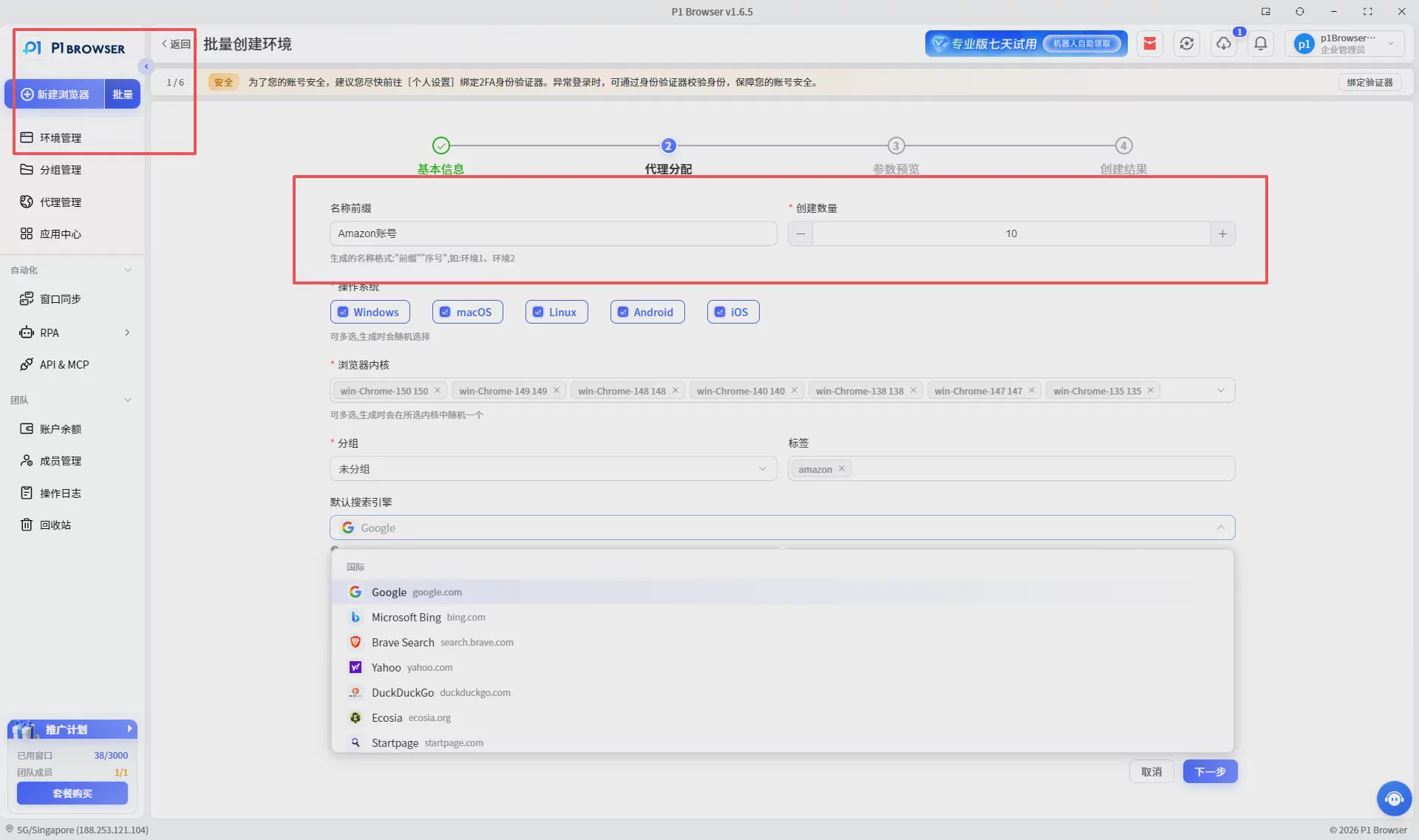
For example:
Amazon账号A
↓
浏览器环境A
↓
负责人A
Amazon账号B
↓
浏览器环境B
↓
负责人B
This way, team members can quickly find the corresponding account and reduce operational errors.
Uniform Management of Account Resources
As the number of accounts increases, more systematic management is needed:
- Account information
- Operations staff
- Environment configuration
- Business purpose
Clear management methods can help teams improve overall efficiency.
VI. How Does P1 Fingerprint Browser Help Amazon Sellers Manage Multiple Accounts?
P1 Fingerprint Browser helps sellers create multiple independent browser environments through browser environment isolation technology.
Each environment can correspond to one Amazon account.
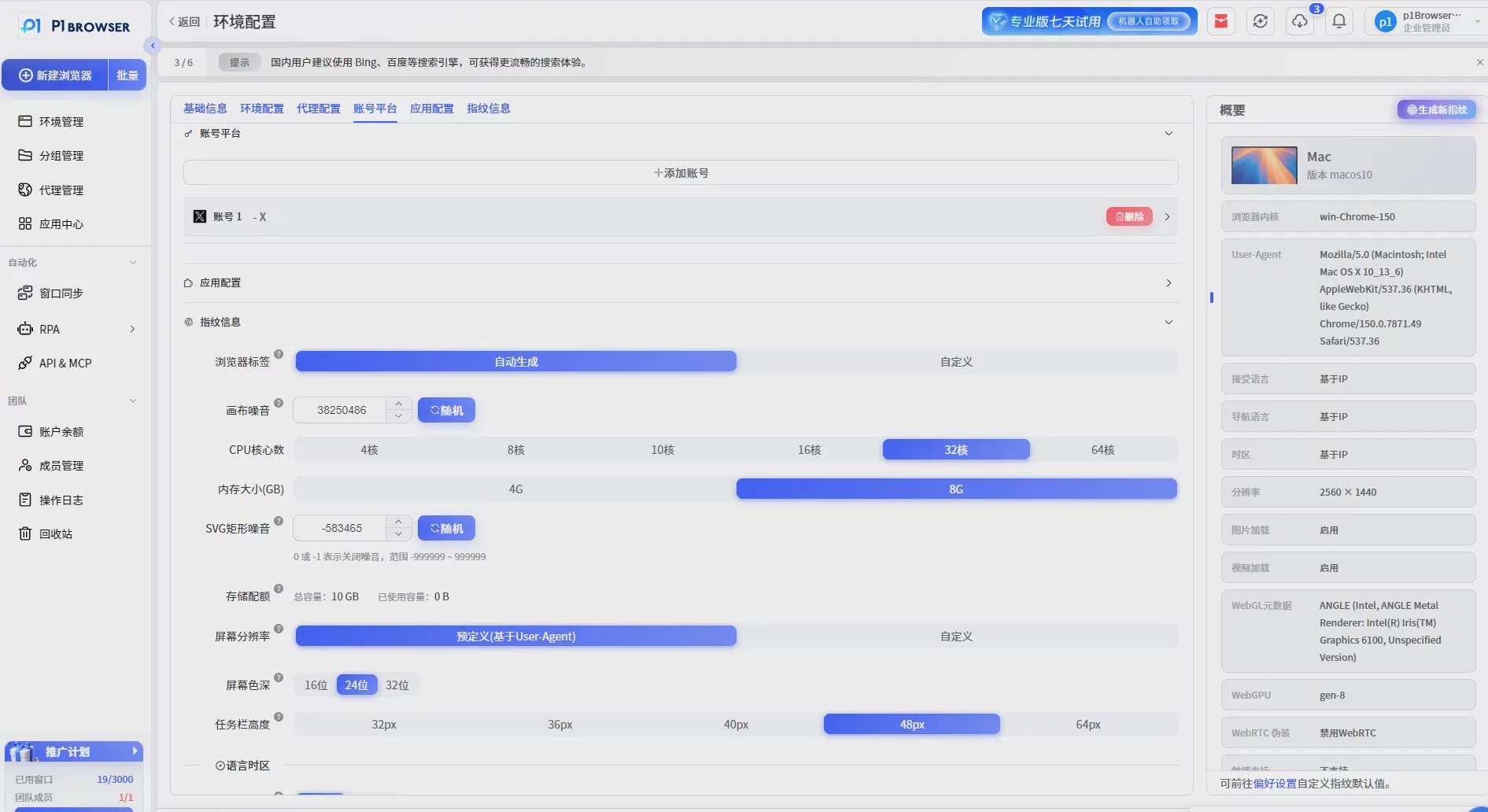
Different environments can be managed separately for:
- Browser fingerprint
- Cookie data
- Login status
- Browser configuration
- Proxy network settings
For example, when a cross-border team operates multiple Amazon Seller accounts simultaneously, they can create corresponding environments for different accounts.
After operations staff enter a designated environment, they only need to manage the corresponding account without repeatedly switching browser configurations.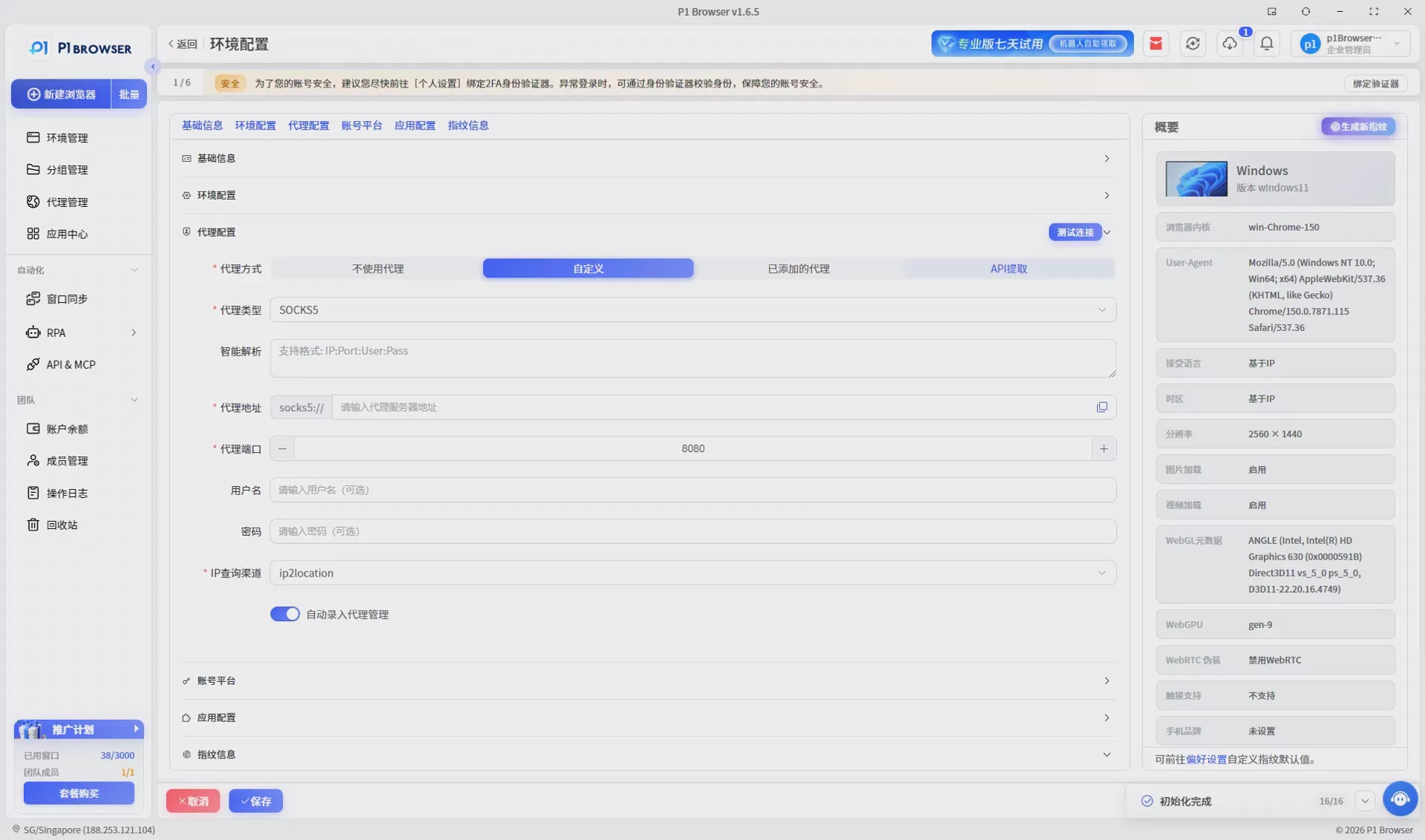
What Amazon Operation Scenarios Is P1 Suitable For?
Multi-Store Operation Teams
Suitable for enterprise sellers who need to manage multiple business accounts, improving team collaboration efficiency.
Cross-Market Operation
For classified account management across different country sites.
Advertising and Data Testing Teams
Convenient for teams to build independent operation environments for different business directions.
VII. Summary: Building a Stable Environment to Improve Multi-Account Operation Efficiency
The core of Amazon multi-account operation is not simply increasing the number of accounts.
What truly matters is establishing a clear and efficient account management system.
Long-term operation of multiple Amazon accounts requires attention to:
- Independent browser environment
- Clear account management method
- Stable operation process
- Team collaboration efficiency
P1 Fingerprint Browser helps cross-border sellers build a more standardized account management environment, allowing multiple Amazon accounts to be operated more efficiently.
Whether for individual sellers, multi-store teams, or enterprise-level cross-border businesses, everyone can optimize their multi-account operation process through P1.